
Economy
OMR 100,000: Muscat Apartment vs Stock Market – Which Investment Builds More Wealth?

Oman’s property market is strengthening, global equities have delivered exceptional returns, and OMR100,000 is enough to make either route meaningful. OERLive investigates what happens when the same capital is deployed into a Muscat apartment or a diversified stock portfolio – and runs the numbers over 10 and 20 years.
OMR 100,000 is a particularly interesting sum of money in Muscat. It is enough to purchase an apartment outright in several established parts of the capital, including some freehold developments. It is also enough to build a substantial globally diversified equity portfolio without borrowing a rial.
At first glance, the investment case appears straightforward. Property produces rent and potentially appreciates. Stocks compound through corporate earnings, dividends and rising share prices.
But comparing the two properly is more complicated.
A property investor pays acquisition costs, service charges and maintenance, carries vacancy risk and eventually needs another buyer to exit. A stock investor gets liquidity and diversification almost instantly, but must tolerate a portfolio that can lose 15%, 20% or considerably more on a screen during a bad year.
And there is another important complication in 2026: both markets have recently performed strongly enough that simply projecting recent gains forward would produce misleading conclusions.
So what could OMR 100,000 realistically do?
First, is Oman’s Real Estate Market Is Genuinely Strengthening?
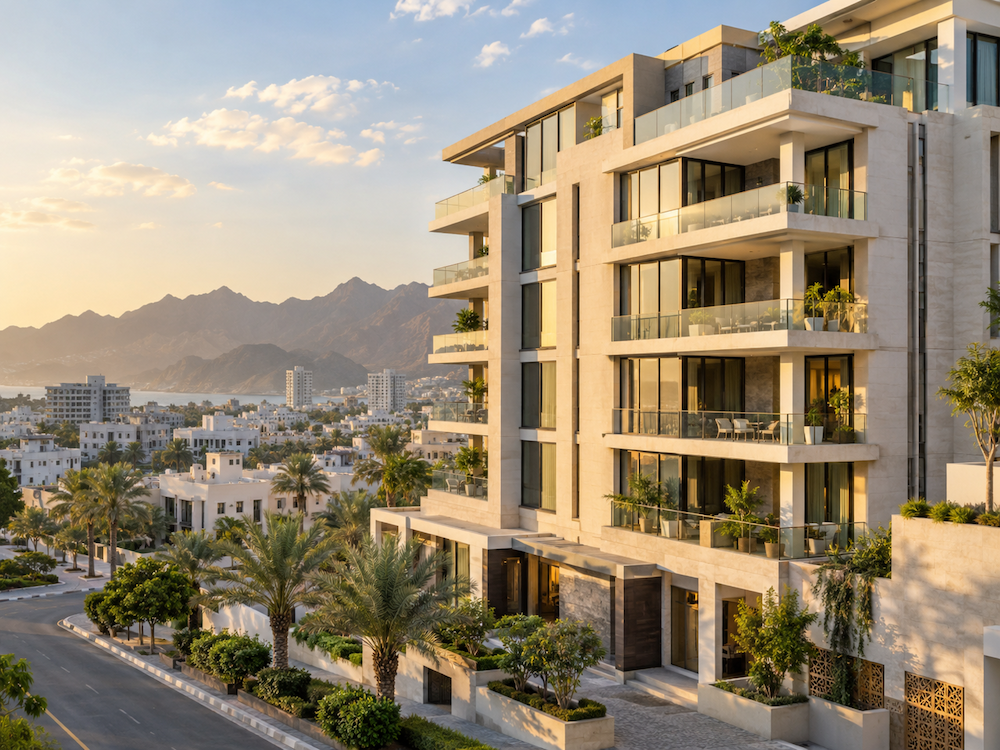
There is little justification for portraying Oman’s property market as weak. In fact, the latest official figures show the opposite.
Oman’s overall real estate price index increased 15.9% year-on-year in the first quarter of 2026, while the residential index rose 17.6%. Meanwhile, villas gained 9% and residential land prices increased 21%.
But one figure matters particularly for this investigation: apartment prices rose by 4.4%. That distinction is crucial because an investor buying an apartment in Muscat cannot reasonably assume that their unit appreciated at the same 17.6% rate as the headline residential index.
The extraordinary part of the current cycle has predominantly been land. Muscat residential land prices increased 43.6% year-on-year in Q1 2026, according to the NCSI figures.
The broader transaction market is also expanding. Savills reported that the total value of property transactions in Oman reached approximately OMR 1.43 billion by the end of June 2026, up 5.4% year-on-year, while the number of property contracts increased 12.2%. Foreign direct investment in Oman’s real estate sector stood at OMR 602.5 million at the end of Q1, up 1.2%.
What Can OMR 100,000 Actually Buy in Muscat?
The budget is realistic. A quick online search shows that and current Muscat Hills asking prices illustrate this. Recent listings have included two-bedroom apartments around OMR 90,000-100,000, with units around the OMR 97,000 mark also appearing in the market. These are asking prices rather than completed transaction valuations, but they demonstrate that OMR 100,000 remains sufficient capital for meaningful apartment ownership in an established Muscat development.
A separate Muscat Hills listing at precisely OMR 100,000 explicitly notes that Ministry of Housing fees and applicable charges are excluded – and this point matters.
For ownership in tourist complexes, the government’s current service schedule includes a charge equivalent to 3% of the property value for expatriates and foreign investors, alongside fixed request, form, title-deed and contract fees totalling OMR 42. Therefore, an investor with exactly OMR 100,000 available as an all-in budget cannot actually purchase a OMR 100,000 apartment without additional cash.
Allowing for the 3% government charge and OMR 42 in listed fixed fees, OERLive calculates that the theoretical maximum property price within a OMR 100,000 all-in budget is approximately: OMR 97,047.
Conversely, buying a property priced at exactly OMR 100,000 would require approximately OMR 103,042 before any brokerage, legal advice, furnishing or other costs that may apply.
That creates an immediate difference from stocks, where almost the entire OMR 100,000 can typically begin working as invested capital.
For non-Omani investors, the legal structure matters as well. Omani law expressly permits Omani and non-Omani individuals and legal entities to own property within authorised Integrated Tourism Complexes, subject to the applicable regulations.
The Rental Yield Can Make Property Extremely Competitive

Property does something a growth stock does not necessarily do: it can generate substantial visible monthly cash flow. Recent Muscat market data show why the rental case deserves serious consideration.
Savills reported average Al Mouj apartment rents of OMR 664 per month in Q2 2026. Qurum apartment rents also recorded substantial growth during the quarter, while demand remained strong in established residential communities.
Area-level property tracking by Oman Property Index currently estimates gross rental yields at approximately:
| Muscat freehold area | Estimated gross yield |
|---|---|
| Al Mouj Muscat | 5.2% |
| Muscat Hills | 6.2% |
| Muscat Bay | 7.0% |
These are area-level estimates rather than guaranteed returns on individual units. And gross is the word investors need to watch.
A 6.2% gross yield does not mean the owner earns 6.2%. Service charges, maintenance, vacancy between tenants and property-management expenses all reduce the number.
Oman Property Index estimates that the difference between gross and net yields can commonly reach 1.5-2.5 percentage points in apartment-heavy communities. Service charges alone in ITC communities are estimated at approximately OMR 3-8 per square metre annually, depending on the development and facilities.
A Muscat Hills apartment producing a 6.2% gross yield, therefore, could conceivably leave something around 3.7-4.7% net after ownership costs, depending heavily on the particular building, occupancy, maintenance requirements and how the unit is managed.
And that net figure – not the advertised gross yield – is what needs to be compared with stocks.
Now Consider the Alternative: Owning the Global Stock Market

For comparison, OERLive is not using speculative individual stocks. The stock-market alternative in this investigation is a diversified equity index portfolio.
The iShares MSCI (ACWI) ETF provides a useful real-world benchmark. As of early September 2026, it held around 2,200 companies spanning developed and emerging markets. Approximately 63.7% of the portfolio was invested in US companies, with further exposure to Japan, Taiwan, the UK, Canada, China, South Korea, France, Switzerland, Germany, Australia, India and other markets. Its stated expense ratio was 0.32%.
That diversification is structurally different from buying one apartment. With a Muscat property, OMR 100,000 may be exposed to: one country, one city, one neighbourhood, one development, one building, and ultimately one tenant at a time.
But a global equity fund spreads that capital across thousands of operating companies. However, stocks come with a different kind of risk.
The Last 10 Years Make Stocks Look Almost Too Good
Through the performance period reported to June 30, 2026, the ACWI ETF recorded a 12.92% annualised 10-year total return, including distributions.
At 12.92% compounded annually, OMR 100,000 would theoretically become more than OMR 336,000 after 10 years.
But using that return as a forecast would be dangerous. The same fund fell 18.27% in 2022 before rebounding 22.22% in 2023, 17.41% in 2024 and 22.43% in 2025.
Stocks make their volatility very visible, and a landlord does not receive an app notification every afternoon telling them their apartment is worth 3% less than it was yesterday.
That psychological difference is significant even when the underlying economic risk may not be as different as the daily price movements suggest.
More importantly, professional forward-looking projections currently look substantially less spectacular than recent historical returns.
Vanguard’s Capital Markets Model, updated in July 2026 using market conditions at June 30, projects 10-year nominal annualised returns of 4.2-6.2% for US equities, while developed markets outside the US are projected at 4.5-6.5%. Vanguard’s expected range for emerging-market equities is lower at 2-4%. It attributes some of the reduced forecast to increasingly stretched equity valuations following strong market gains.
That creates an interesting conclusion. A good Muscat apartment may be considerably more competitive with stocks over the next decade than a backward-looking S&P 500 chart would suggest.
So What Happened When We Ran the Numbers?
Rather than claiming either asset will deliver one specific return, OERLive constructed three scenarios.
For the property calculation, we assume:
- OMR 100,000 total starting capital.
- Approximately OMR 97,047 purchase price after the current 3% government charge and listed fixed fees.
- Cash purchase with no mortgage.
- Net rental yields of 3%, 4% and 5%.
- Rent increases by a modest modelled 2% annually.
- Property price appreciation of 0%, 3% and 5% annually.
- No selling costs, furnishing costs or taxes included.
- Returns calculated using investment cash flows and the eventual property value.
The resulting approximate internal rates of return are:
| Property scenario | Net rental yield | Property appreciation | 10-year annualised IRR |
|---|---|---|---|
| Conservative | 3% | 0% | 2.9% |
| Middle case | 4% | 3% | 6.5% |
| Strong case | 5% | 5% | 9.1% |
These are OERLive modelling scenarios, not forecasts, and the middle scenario is particularly instructive.
A property that generates a genuine 4% net rental yield, increases rent modestly and appreciates by 3% annually produces an estimated investor return of approximately 6.5% a year over ten years after accounting for the initial government acquisition charge.
That is an entirely credible wealth-building return. It also sits around the upper portion of Vanguard’s current forward range for major developed equity markets.
What Does OMR 100,000 Become in Stocks?
For the stock portfolio, rather than extrapolating the recent 12.92% historical ACWI return, OERLive uses three deliberately more restrained total-return scenarios: 5%, 7% and 9% annually.
Assuming distributions (dividends) are reinvested:
| Annual stock return | After 10 years | After 20 years |
|---|---|---|
| 5% | OMR 162,889 | OMR 265,330 |
| 7% | OMR 196,715 | OMR 386,968 |
| 9% | OMR 236,736 | OMR 560,441 |
This is where compounding starts to become enormously important. The difference between 5% and 9% on OMR 100,000 is only four percentage points per year. After 20 years, however, the difference in ending wealth is almost OMR 295,000.
The Most Important Number in This Investigation: 3.6%
There is another way to frame the property-versus-stocks question. Suppose the Muscat apartment produces a sustainable 4% net rental yield and rent grows 2% annually.
How much must the apartment itself appreciate to compete with stocks? OERLive’s model produces the following approximate break-even rates over ten years:
| Stock-market return to beat | Required annual apartment appreciation* |
|---|---|
| 5% | 1.25% |
| 7% | 3.63% |
| 9% | 5.95% |
*Assuming a 4% starting net rental yield, 2% annual rent growth and the current 3% acquisition charge.
This may be the most revealing result in the entire comparison. A Muscat apartment does not need to rise by 10% every year to compete with equities.
If it can genuinely produce 4% net cash yield, price appreciation of around 3.6% annually is enough in our model to broadly match a stock portfolio compounding at 7%. For context, Oman’s apartment price index increased 4.4% year-on-year in Q1 2026.
If an investor could somehow sustain 4.4% apartment appreciation for ten consecutive years alongside a 4% net rental yield, the property economics would be extremely attractive.
But that is precisely where disciplined analysis is required. One year of 4.4% appreciation is evidence of current market momentum. It is not evidence that apartments will appreciate 4.4% every year until 2036.
The same warning applies to stocks; a 12.92% trailing 10-year global-equity return is historical evidence, not a promise for the next decade.
Where the Apartment Has an Advantage

1. It produces substantial cash income
A properly selected apartment can generate monthly rental income immediately. Investors seeking dependable cash flow may value this differently from an accumulating equity portfolio.
2. You can actually use it
This is perhaps property’s biggest hidden advantage. If the owner lives in the apartment, the investment generates an implicit return through rent that no longer needs to be paid.
That fundamentally changes the comparison. A stock portfolio may generate greater financial wealth while the investor simultaneously spends thousands of rials every year renting a home. An owner-occupier combines investment and consumption in one asset.
3. Property can be financed
Our investigation deliberately compares cash with cash – but property investors can use mortgages. If a buyer puts OMR 40,000 into a OMR 100,000 apartment and finances the remainder, a 5% increase in the value of the property represents OMR 5,000 of asset appreciation against only OMR 40,000 of initial equity.
That leverage can significantly enhance returns. It can also magnify losses and create negative cash flow when mortgage payments exceed net rent, so leveraged property is a different risk proposition from the cash comparison in this investigation.
4. Illiquidity can sometimes help
Being unable to sell an apartment in 30 seconds has an odd behavioural advantage. Property owners are less likely to panic because of one bad week. Equity investors technically have superior liquidity, but that liquidity only helps if they have the discipline not to use it badly.
Where Stocks Have the Advantage
1. Diversification is difficult to match
An OMR 100,000 apartment remains one physical asset. The ACWI example spreads money over roughly 2,200 companies.
A defective building, unusually high service charges, a weak tenant market or excessive new supply near one apartment can have an outsized effect on a property investor. In retrospect, no individual building can destroy a global index portfolio.
2. Transaction friction is much lower
The government’s 3% property acquisition charge means part of the property investor’s capital is consumed before the asset has appreciated by a single rial. By comparison, the ACWI ETF recently showed a median bid-ask spread of around 0.01%, although investors may separately face brokerage, currency-conversion, taxation and other costs depending on how and where they invest.
3. Liquidity is dramatically better
An ETF can normally be sold during market hours. A property requires marketing, negotiation, legal transfer and a willing buyer.
That makes equities much more suitable for capital that could be needed unexpectedly.
4. Rebalancing is easy
An investor can sell OMR 5,000 of stocks. Selling 5% of an apartment is generally not an option, and that matters when building a diversified long-term portfolio.
One Oman-Specific Advantage for Dollar Investments
The Omani rial has maintained a fixed exchange-rate peg to the US dollar at USD 2.6008 per OMR since 1986, according to the Central Bank of Oman. Therefore, while the peg remains in place, an Oman-based investor buying USD-denominated assets does not experience the same direct OMR-versus-USD exchange-rate volatility faced by investors whose home currencies float freely against the dollar.
That does not remove currency risk from a global portfolio – companies and assets around the world remain exposed to yen, euro, sterling, yuan and many other currencies – but it simplifies the OMR/USD component of international investing.
The Tax Equation Is Also About to Change
Long-term comparisons should also acknowledge that Oman’s tax environment will not remain exactly as it is today. Oman’s Personal Income Tax law will take effect from the beginning of 2028, applying a 5% rate to taxable income for individuals whose total annual income exceeds OMR 42,000. The Tax Authority estimates roughly 99% of the population will remain outside its scope.
The Tax Authority has specifically confirmed that qualifying residential rental income falls within the PIT framework, while the IMF’s analysis of the legislation notes that the system encompasses investment income and capital gains, subject to the law’s exemptions and deductions.
Foreign securities can also carry withholding and fund-domicile implications. For that reason, OERLive’s return models are presented before individual taxation. The precise after-tax outcome will depend on the investor, residency status, type of investment, fund structure and the final application of Oman’s regulations.
So, What’s The Verdict?
If the question is simply: “Which has gone up more recently?” then stocks win easily.
A global-equity fund returning almost 13% annually over the past decade is difficult for an unleveraged residential apartment to match. But that is not the correct investment question as we sit here in September 2026.
Equity valuations have risen substantially, and one of the world’s largest asset managers now expects considerably lower US and developed-market returns over the next decade than investors enjoyed over the previous ten years.
At the same time, Oman enters the comparison with a property market recording rising transaction values, growing foreign real-estate investment, strong activity in selected Muscat residential markets and meaningful rental yields.
For an investor whose sole objective is maximum liquid, diversified long-term financial wealth, global equities retain major structural advantages. They provide instant diversification, almost frictionless reinvestment and vastly greater liquidity.
But the numbers do not justify dismissing Muscat property. A carefully purchased apartment generating around 4% net rent and 3% annual capital appreciation produces roughly a 6.5% modelled return in our cash-purchase scenario.
And at that 4% net yield, only around 3.6% annual property appreciation is required to compete with a 7% stock-market return over ten years.
That is achievable territory – although certainly in either is not guaranteed territory. The balance shifts further towards property if the investor intends to live in the apartment, can purchase below prevailing market value, secures an unusually strong rental yield, or uses prudent leverage.
Conversely, the balance shifts towards stocks if the investor already owns a home, values immediate liquidity, wants geographic diversification outside Oman, does not want to manage tenants and maintenance, or expects the apartment’s net yield or appreciation to be weak.
Perhaps the clearest conclusion is therefore not “property versus stocks”.
It is this: OMR 100,000 in a good Muscat apartment can be an effective wealth-building asset. OMR 100,000 in global equities can be an exceptionally efficient compounding asset. The deciding variable is whether the investor values the income, utility and local exposure of property more than the liquidity, diversification and frictionless compounding of the stock market.
And for someone whose OMR 100,000 represents most of their accumulated wealth, there is an even more fundamental question worth asking: why must the answer necessarily be 100% of either one?
A home and a global portfolio perform different economic jobs. And for many long-term investors in Oman, owning exposure to both may ultimately prove more resilient than trying to predict which one will win the next decade.
OERLive Research Note: Calculations in this investigation are illustrative scenario analyses based on the cited market data and stated assumptions. They are not forecasts or recommendations to purchase any particular property, security or investment fund. Individual transaction costs, financing, taxation, service charges, realised rents, vacancies and investment returns can materially alter outcomes.
Note to readers: All images featured in this article are generated with AI models. Images of characters are not meant to depict any individual – either living or otherwise.



Win OMR 3,000: ROP & Bank Muscat Launch Cyber Fraud Awareness Short Film Competition

EXCLUSIVE INTERVIEW: Yango’s Big Vision for Oman

Leadership, Transformation Forum Reviews Inspiring Women’s Experiences

OPINION: GCC Navigates Global Macro Volatility as Worldwide Growth Moderates to 2.6%

City Centre Muscat Celebrates 25 Years of Great Moments as Mall of Oman Marks Its Fifth Anniversary

HM The Sultan Accorded Official Reception Ceremony at Windsor Castle

61.7% of Middle Eastern Families Involve the Next Generation As Business Successors or Consultants

Future Fund Oman’s $5.2B Outlook: Where Will the Sultanate’s Next Big Businesses Come From?

Oman and the UK: From Historical Legacy of Over 220 Years to Future Partnership

Sohar International Launches Expatriate Banking Proposition with Housing Loans, Cashback, Insurance & Digital Remittance Solutions

Power And Beyond: The Path To A Low-carbon Future

Al Mouj Muscat unveils Ghadeer Villas

Time to Buy Saudi Stocks? Some Investors Look at Dubai Instead

Hospitality Industry in Oman Estimated 90% Growth in 2022

Renewables are booming, but not fast enough to cap greenhouse emissions

Retail Abu Dhabi’s ‘Unbox Amazing’ generates sales of more than AED 2 billion in participating stores

Saudis Sign Deals From Energy to Metals in Bid to Salvage Forum

Saudi Arabia’s Gold Miner Plans to Be a Global Top-20 Supplier

Technology to drive Sultanate’s downstream industry

Digitization and Logistics Service Providers Can Help SMEs Make the Most of Peak Season Retail Trends

VIDEO: Building Oman’s Future – SAH’s Vision for Infrastructure, Innovation and Growth

VIDEO: Oman Cables Breaks Ground on OMR 10 Million-Plus Plant to Power Oman’s Industrial Future

VIDEO: Hitesh Akarte on Khimji Ramdas Infrastructure’s Role in Oman Vision 2040

Oman’s Hospitality Sector Enters a New Phase of Growth: Sadiq Al Matwani Al Lawati

Amr Baabood: Oman Climate Week Is About Moving From Climate Ambition to Climate Action

Mayan Al Asfoor on Leadership, Legacy and Empowering Omani Talent

LEADERSPEAK: Dhofar Insurance CEO Sunil Kohli on Oman’s Insurance Sector, Reinsurance & Market Outlook

VIDEO: Robert MacLean on how NHI is Shaping Oman’s Next Generation of Hospitality Leaders

The Future of Oman: Decoding The Sultanate of Oman’s Strategic Promotional Nation Brand

EXCLUSIVE: AI, Robotics & Wearable Sensors are Changing the Lives of Dementia Patients
-

 Artificial Intelligence1 month ago
Top 5 Interesting Things AI Did This Month – September 2026 Edition
-

 Fashion4 weeks ago
Luxury Watches That Could Appreciate Over the Next Decade [2026 Auction Buyer Guide]
-

 Economy3 weeks ago
OER Magazine September Edition 2026
-

 Banking & Finance2 months ago
The GCC’s 10 Richest Billionaires: Inside US$253.5 Billion of Wealth
-

 Banking & Finance1 month ago
INVESTIGATION: What If You Bought Apple Stock Every Time You Bought an iPhone?
-

 Alamaliktistaad Magazines2 weeks ago
Alam Al-Iktisaad Magazine September 2026 Edition
-

 News2 months ago
OPEC+ Holds Output Steady for October as Focus Shifts to 2027 Quotas
-

 Artificial Intelligence1 month ago
What the World’s Top 10 Tech CEOs Really Earn