
Banking & Finance
Invest It All or Invest Gradually – Which Strategy Builds More Wealth Over Time?

Investing everything immediately has historically produced the stronger return more often. Yet spreading an investment over time can protect investors from another serious risk – their own reaction to a badly timed market fall.
Imagine receiving an OMR 12,000 bonus, inheritance or maturity payment. Should the entire amount be invested immediately, or divided into OMR 1,000 monthly investments over the next year?
This is the central question behind the debate between lump-sum investing and dollar-cost averaging, commonly known as DCA.
The mathematical answer is relatively straightforward: if markets are expected to rise over time, investing earlier gives capital more time to compound. The practical answer is more complicated because markets do not rise smoothly – and investors do not always behave rationally when their savings fall sharply.
The best strategy is therefore not necessarily the one with the highest theoretical return. It is the one that combines return potential, risk capacity, liquidity needs and the investor’s ability to remain invested.
What exactly is DCA?
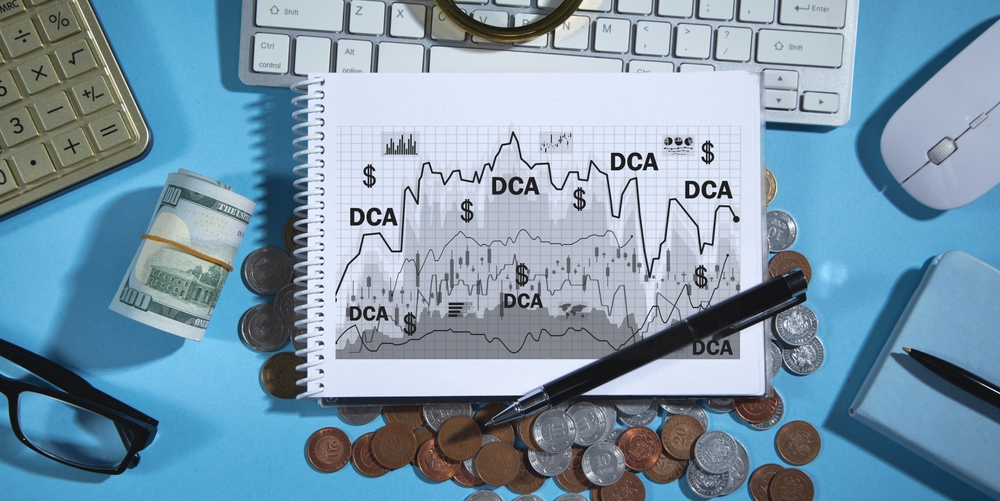
Dollar-cost averaging means investing equal amounts at regular intervals, regardless of market conditions. An investor placing OMR 100 into an exchange-traded fund every month will purchase more units when prices are low and fewer when they are high.
The strategy should not be confused with waiting indefinitely for a “better entry point”. DCA follows a predetermined schedule; market timing relies on predicting what prices will do next.
There is also an important distinction between two situations:
- A salaried investor placing part of each monthly income into the market is investing money as it becomes available.
- An investor holding OMR 12,000 in cash and deliberately investing it over 12 months is temporarily delaying market exposure.
Only the second investor faces a genuine lump-sum-versus-DCA decision.
Why the numbers favour lump-sum investing
Markets have historically delivered positive returns over sufficiently long periods. Consequently, capital invested today generally has a higher expected return than capital waiting in cash.
Vanguard examined rolling one-year periods across several markets between 1976 and 2022. Its research found that immediate lump-sum investing beat cost averaging approximately 61.6% to 73.7% of the time, depending on the market studied. Longer deployment periods increased the historical advantage of investing immediately.
Vanguard’s research does not guarantee that lump-sum investing will win in any particular year, but it illustrates the opportunity cost created by holding investible money outside the market.
The underlying principle is simple: markets have an upward long-term bias because profitable businesses grow, economies expand and shareholders receive dividends. The S&P 500, for example, has produced an annualised total return of approximately 10% since its 1957 launch, although the journey included recessions, crashes and extended periods of disappointing performance. S&P Dow Jones Indices also notes that its historical bear markets involved an average peak-to-trough fall of approximately 33%.
Past returns should never be treated as a promise. They do, however, explain why “time in the market” generally has a higher expected value than waiting in cash.
An OMR 12,000 example
Consider an investor with OMR 12,000 and two choices:
- Invest all OMR 12,000 at the beginning of the year.
- Invest OMR 1,000 at the beginning of every month for 12 months.
The following simplified scenarios assume the market moves steadily through the year. They exclude transaction costs, taxes and any interest earned on uninvested cash.
| Market outcome after one year | Lump sum | 12-month DCA | Better result |
|---|---|---|---|
| Market rises 12% | OMR 13,440 | Approximately OMR 12,766 | Lump sum by OMR 674 |
| Market remains flat | OMR 12,000 | OMR 12,000 | Equal |
| Market falls 20% | OMR 9,600 | Approximately OMR 10,656 | DCA by OMR 1,056 |
When the market rises, the lump sum benefits because the full amount participates in the increase. When the market falls, DCA performs better because much of the capital enters at progressively lower prices.
The dilemma is that investors know the outcome only after it happens. Cash interest can narrow the difference while the uninvested portion waits, but it does not change the basic trade-off: lump-sum investing maximises market exposure, while DCA reduces the risk of committing everything immediately before a fall.
The psychological case for DCA
DCA is frequently presented as a return-enhancing strategy. More accurately, it is a risk-management and behavioural tool.
Suppose an investor places OMR 12,000 into an equity ETF and the market falls 25% within three months. The account would temporarily decline to approximately OMR 9,000. Even if the investment later recovers, the investor may panic, sell and permanently convert the paper loss into a real one.
An investor using DCA would still experience losses on the amounts already invested, but would also continue buying at lower prices. That can make market volatility feel productive rather than catastrophic.
DCA therefore makes sense when it prevents a larger behavioural mistake. Giving up some expected return may be worthwhile if the alternative is remaining entirely in cash, continually delaying the decision or selling during the first correction.
However, DCA works only if the schedule is followed. Suspending contributions after prices fall removes one of the strategy’s main advantages.
What compounding can do

Timing the initial investment matters, but asset allocation, fees and the length of the holding period will normally have a much greater effect on long-term wealth.
Consider OMR 10,000 invested for 15 years. These are hypothetical constant-return scenarios, not forecasts for specific products:
| Assumed annual return | Value after 15 years |
|---|---|
| 4% | OMR 18,009 |
| 5% | OMR 20,789 |
| 6% | OMR 23,966 |
| 8% | OMR 31,722 |
| 10% | OMR 41,772 |
At an illustrative 8% return, OMR 10,000 grows to approximately OMR 31,722 without additional contributions.
Regular saving can be even more powerful. Investing OMR 100 every month for 15 years at an illustrative 8% annual return would produce approximately OMR 33,978, despite total contributions being only OMR 18,000.
These figures are nominal and exclude inflation, fees and taxes. At 3% annual inflation, OMR 31,722 received in 15 years would have purchasing power equivalent to roughly OMR 20,350 today. Growing the account balance is therefore only part of the objective; the investment must also grow faster than the investor’s costs and inflation.
Where should the money be invested?
The choice between lump sum and DCA should come only after deciding what the money is for. A sum required for a home deposit next year should not be invested like retirement capital that will remain untouched for 20 years.
The US Securities and Exchange Commission’s investor guidance emphasises that asset allocation should reflect both an investor’s time horizon and capacity to tolerate losses. Longer horizons can generally accommodate more volatility, while shorter horizons call for more stable and liquid assets.
Fixed deposits and cash
Fixed deposits can be appropriate for emergency reserves, near-term expenses and investors who cannot accept capital losses.
Their strengths are predictability and simplicity. Their weaknesses, however, are inflation risk, reinvestment risk when the deposit matures and the possibility that early withdrawal will reduce the return.
An investor should compare the effective annual rate, deposit period, early-withdrawal terms and the financial institution’s regulatory status – not only the advertised headline rate.
Cash is not necessarily a poor asset; it is simply an asset designed primarily for liquidity and stability, rather than maximum long-term growth.
Bonds and sukuk

Government bonds, investment-grade corporate bonds and sukuk can provide income and reduce portfolio volatility. They may suit medium-term goals or form the defensive component of a diversified portfolio.
However, bonds are not risk-free either: their market prices can fall when interest rates rise, longer-maturity securities are generally more rate-sensitive, and corporate issuers can default. Investors comparing bonds should look at yield to maturity, credit quality, maturity and liquidity rather than the coupon alone.
Oman-based investors can also examine bonds, sukuk and funds listed through the Muscat Stock Exchange, alongside appropriately regulated international fixed-income products.
Broad-market ETFs
For long-term wealth accumulation, a low-cost diversified equity ETF can provide a simpler foundation than selecting multiple individual companies.
An S&P 500 ETF offers exposure to 500 leading US companies representing approximately 80% of the available US market capitalisation. It is diversified across many businesses, but it is still concentrated in one country, weighted heavily towards its largest companies and influenced by the performance of major technology groups.
Alternatives include:
- A total-US-market ETF containing large-, mid- and small-cap companies.
- A developed-markets ETF adding Europe, Japan and other advanced economies.
- An emerging-markets ETF providing exposure to faster-growing but more volatile economies.
- A global or all-world ETF combining US and non-US markets in one fund.
- Bond ETFs for diversified fixed-income exposure.
The case for passive ETFs is strengthened by the difficulty of consistently selecting winning shares or fund managers. In 2025, 79% of actively managed US large-cap equity funds underperformed the S&P 500, according to the SPIVA US Scorecard.
Individual stocks

Individual shares can generate exceptional returns, but they also introduce company-specific risk. A diversified ETF can survive the decline of an individual constituent; a concentrated portfolio may not.
Investors who enjoy researching businesses could use a broad-market ETF as the core of the portfolio and maintain a smaller “satellite” allocation for selected companies. That approach preserves room for conviction while limiting the damage one failed investment can cause.
The analysis should cover revenue growth, profitability, cash flow, debt, valuation, competitive advantage and management quality andnot simply whether the company’s products are popular.
Investing abroad from Oman
International markets can give Oman-based investors access to sectors and companies not represented locally. They also introduce operational, regulatory, tax and currency considerations.
The Omani rial has maintained a fixed parity of approximately USD 2.6008 per OMR since 1986, according to the Central Bank of Oman. This reduces direct OMR–USD exchange-rate volatility for US-dollar investments, although it does not remove market risk or the currency exposures of multinational companies and non-US assets.
Before transferring money, an investor should examine:
- Which legal entity actually operates the brokerage account.
- The regulator supervising that entity.
- Whether client securities are segregated from the broker’s own assets.
- Whether the investor owns the underlying shares or only a derivative or synthetic claim.
- Trading commissions, custody charges, inactivity fees and foreign-exchange spreads.
- Whether the broker permits asset transfers to another institution.
- The ETF’s domicile, expense ratio, distribution policy and tax treatment.
The domicile of an ETF can matter as much as the exchange on which it trades. For example, CSPX is an Ireland-domiciled, accumulating UCITS ETF tracking the S&P 500 with a stated annual expense ratio of 0.07%. This is an illustration rather than a recommendation.
Oman-based investors purchasing US-domiciled securities should also obtain tax advice. The US generally withholds 30% from US-source dividends paid to non-resident aliens unless a lower treaty rate applies. US-situated assets can also create estate-tax filing considerations for non-US citizens and residents; the IRS states that Form 706-NA may be required when such assets exceed USD 60,000 at death. IRS dividend guidance and IRS estate-tax guidance should be considered alongside professional advice on the investor’s residence, nationality and the fund’s structure.
Investors should also verify firms through the Oman Financial Services Authority’s Investor Protection Portal, particularly when dealing with platforms marketing foreign securities.
So what is a practical decision framework?
Lump-sum investing may be more suitable when:
- The money will not be needed for at least seven to ten years.
- The investor already has an emergency fund.
- The chosen portfolio is diversified.
- The investor can tolerate a substantial temporary decline.
- The money is genuinely available now.
DCA may be more suitable when:
- A sharp loss immediately after investing could cause panic selling.
- The investor is moving from cash into volatile assets for the first time.
- The amount is psychologically large relative to existing wealth.
- A written, automatic investment schedule can be maintained.
- The cost of each trade and currency conversion is sufficiently low.
A hybrid strategy can bridge the two. An investor might place 50% into the target portfolio immediately and invest the balance automatically over three to six months. With OMR 12,000, that could mean OMR 6,000 invested now and OMR 1,000 monthly over the following six months.
The hybrid approach will not mathematically optimise every possible market outcome. Its advantage is that the investor gains meaningful exposure immediately while reducing the regret associated with committing everything on a single date.
This article is for general educational purposes and does not constitute personalised investment, legal or tax advice. Investment values can rise or fall, and historical returns do not guarantee future performance.



The Hidden Price of Convenience: What People in Oman Spend on Food Delivery, Coffee & Subscriptions

VIDEO: Oman Cables Breaks Ground on OMR 10 Million-Plus Plant to Power Oman’s Industrial Future

Liva Insurance Recognised for Leadership in Insurance Innovation and Digital Transformation at OERLive DX Oman

Oman Air Launches Winter Schedule with Additional Frequencies, Expanded Capacity & New Codeshare Destinations

IHE and Eicher Trucks and Buses promote school bus safety awareness among students

India’s rising edge in oil, gas and construction projects is enabling Middle East’s growth

The Financial Services Authority organises the National Health Insurance Platform Forum ‘Dhamani’

Is India’s accelerating export engine driving manufacturing towards global scale?

SAH wins double honours at Dossier Construction Awards & Summit 2026

VIDEO: Hitesh Akarte on Khimji Ramdas Infrastructure’s Role in Oman Vision 2040

Power And Beyond: The Path To A Low-carbon Future

Al Mouj Muscat unveils Ghadeer Villas

Time to Buy Saudi Stocks? Some Investors Look at Dubai Instead

Hospitality Industry in Oman Estimated 90% Growth in 2022

Renewables are booming, but not fast enough to cap greenhouse emissions

Retail Abu Dhabi’s ‘Unbox Amazing’ generates sales of more than AED 2 billion in participating stores

Saudis Sign Deals From Energy to Metals in Bid to Salvage Forum

Saudi Arabia’s Gold Miner Plans to Be a Global Top-20 Supplier

Technology to drive Sultanate’s downstream industry

Digitization and Logistics Service Providers Can Help SMEs Make the Most of Peak Season Retail Trends
VIDEO: Oman Cables Breaks Ground on OMR 10 Million-Plus Plant to Power Oman’s Industrial Future
VIDEO: Hitesh Akarte on Khimji Ramdas Infrastructure’s Role in Oman Vision 2040

Oman’s Hospitality Sector Enters a New Phase of Growth: Sadiq Al Matwani Al Lawati

Amr Baabood: Oman Climate Week Is About Moving From Climate Ambition to Climate Action

Mayan Al Asfoor on Leadership, Legacy and Empowering Omani Talent

LEADERSPEAK: Dhofar Insurance CEO Sunil Kohli on Oman’s Insurance Sector, Reinsurance & Market Outlook

VIDEO: Robert MacLean on how NHI is Shaping Oman’s Next Generation of Hospitality Leaders

The Future of Oman: Decoding The Sultanate of Oman’s Strategic Promotional Nation Brand

EXCLUSIVE: AI, Robotics & Wearable Sensors are Changing the Lives of Dementia Patients

EXCLUSIVE: Talking Renewable Projects & Sustainability in Oman and Beyond with Vipul Tuli
-

 Artificial Intelligence1 month ago
Top 5 Interesting Things AI Did This Month – September 2026 Edition
-

 Fashion3 weeks ago
Luxury Watches That Could Appreciate Over the Next Decade [2026 Auction Buyer Guide]
-

 Economy2 weeks ago
OER Magazine September Edition 2026
-

 Banking & Finance1 month ago
The GCC’s 10 Richest Billionaires: Inside US$253.5 Billion of Wealth
-
 Magazines2 months ago
OER Magazine July Edition 2026
-

 Magazines2 months ago
Al Mar’a Magazine July 2026
-

 Alamaliktistaad Magazines2 months ago
Alam Al-Iktisaad Magazine July 2026 Edition
-

 Banking & Finance1 month ago
INVESTIGATION: What If You Bought Apple Stock Every Time You Bought an iPhone?