
Automotive
Electric vs Petrol: Which Is Actually Cheaper to Run in Oman?
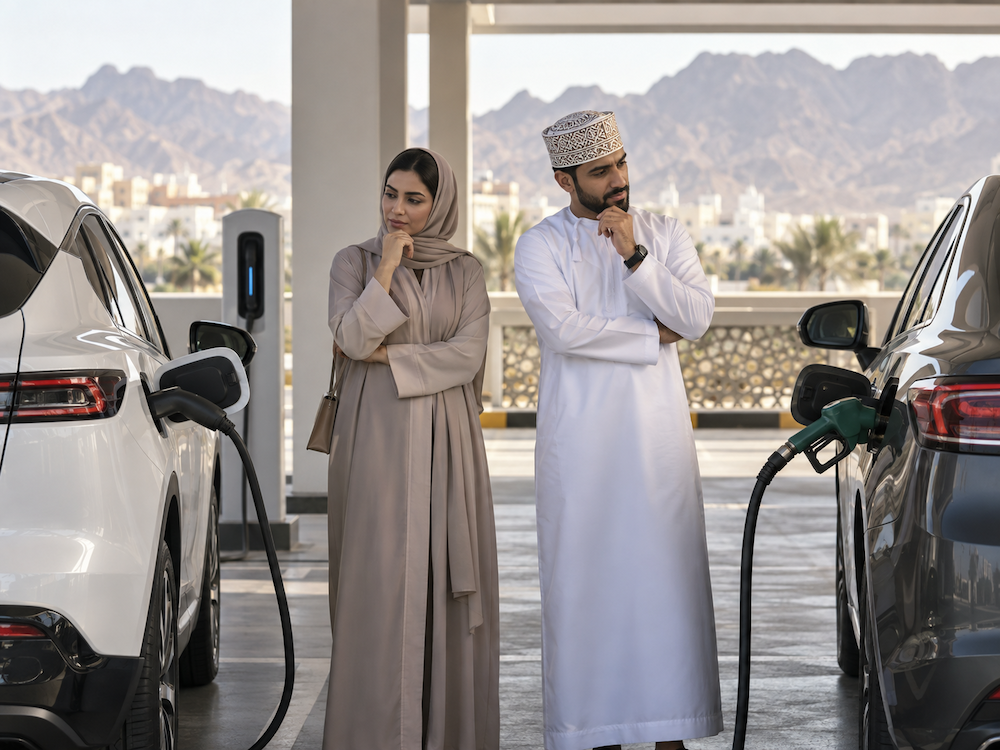
OERLive analysis finds that electric cars remain exceptionally cheap to run when charged at home in Oman. But once drivers become dependent on the fastest public chargers, the calculation becomes considerably more complicated.
From October 1, 2026, charging an electric vehicle at public charging stations in Oman will no longer have one simple cost. The Ministry of Transport, Communications and Information Technology (MTCIT), in coordination with the Authority for Public Services Regulation (APSR) and Oman Net Zero Centre, has approved three charging bands: 50 Baisa per kilowatt-hour for chargers of 90kW or below, 90 Baisa for chargers between 91kW and 180kW, and 120 Baisa for chargers rated at 181kW or higher.
The official study underpinning the tariffs concluded that charging EVs at service stations remains cheaper than operating gasoline-powered vehicles. But how does that claim translate into actual kilometres driven – especially in a country like Oman where petrol itself remains relatively inexpensive?
OERLive ran the numbers… and the answer is clear at home, but considerably more nuanced on the road.
The Short Answer
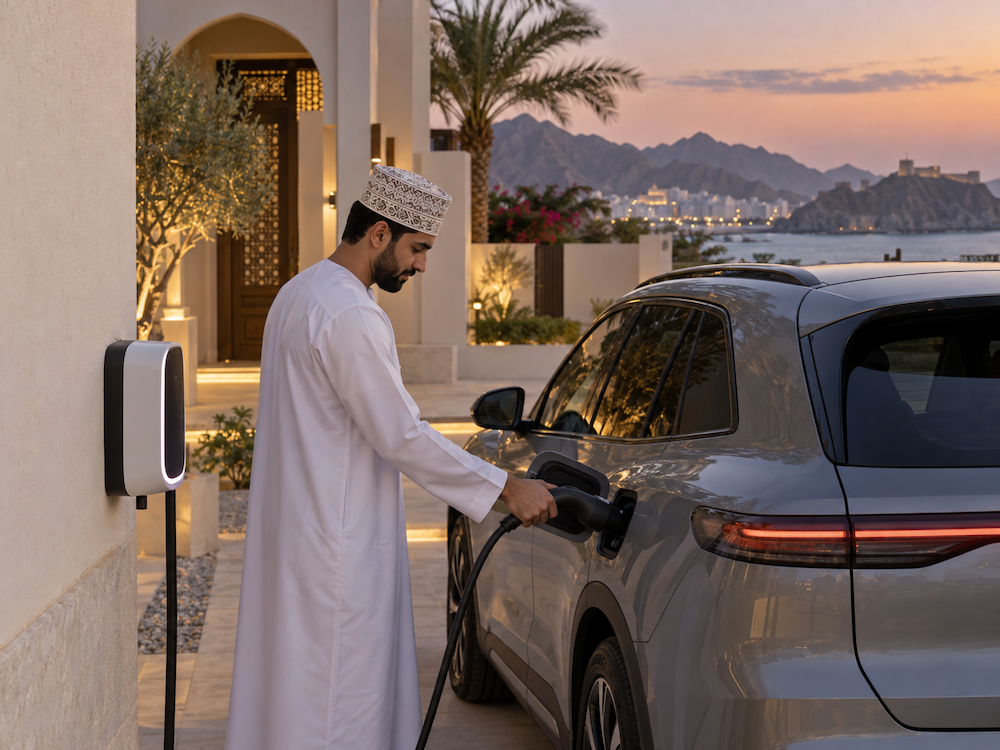
If you can regularly charge an EV at home, the EV is overwhelmingly cheaper to run than a comparable petrol car in Oman. At the lowest standard residential electricity tariff of 14 Baisa/kWh, a representative EV consuming 18kWh per 100km costs only around OMR0.25 to travel 100km.
Even at the highest 32 Baisa residential slab, that rises to only around OMR0.58 per 100km. By comparison, a petrol vehicle consuming 8 litres per 100km costs approximately OMR1.91 per 100km using M95 petrol at September 2026 prices.
But public fast charging changes the equation:
- At 50 Baisa/kWh, the same EV costs approximately OMR0.90 per 100km.
- At 90 Baisa/kWh, it rises to OMR1.62.
- And at 120 Baisa/kWh, electricity costs approximately OMR2.16 per 100km, which is enough for some efficient petrol cars to become cheaper on energy cost alone.
What Does Petrol Currently Cost in Oman?
As of September 2026, Oman Oil Marketing Company lists:
| Fuel | Price |
|---|---|
| M91 petrol | 229 Baisa/litre |
| M95 petrol | 239 Baisa/litre |
| Diesel | 258 Baisa/litre |
These prices are important because Oman remains a market where the cost of running an efficient combustion-engine vehicle is relatively low when compared with the rest of the world. But for this analysis, OERLive primarily uses M95 at OMR0.239 per litre, while also looking at highly efficient petrol vehicles to avoid unfairly comparing an EV only with large SUVs.
The OERLive Running-Cost Test
To make the comparison understandable, we use a representative EV consuming: 18kWh per 100km. That is deliberately more conservative than the laboratory consumption figures of some highly efficient electric sedans.
For example, Tesla lists official consumption of just 13.0kWh/100km for the rear-wheel-drive Model 3 in the UAE market. Real-life consumption can be higher because of speed, acceleration, tyre size, road conditions, humidity, and importantly in Oman, air-conditioning.
Research from the US National Renewable Energy Laboratory has established that cabin climate control is one of the largest auxiliary power loads in an EV and that air-conditioning negatively affects range in warm weather.
Using 18kWh/100km therefore gives us a more conservative Oman-oriented working assumption rather than relying solely on an ideal laboratory figure.
EV Cost per 100km in Oman
Using the new charging tariffs:
| Where the EV is charged | Electricity price | Cost per 100km at 18kWh/100km |
|---|---|---|
| Home: primary account, first slab | 14bz/kWh | OMR0.25 |
| Home: primary account, second slab | 18bz/kWh | OMR0.32 |
| Home: additional account, first slab | 22bz/kWh | OMR0.40 |
| Home: additional account, second slab | 26bz/kWh | OMR0.47 |
| Home: highest residential slab | 32bz/kWh | OMR0.58 |
| Public charger ≤90kW | 50bz/kWh | OMR0.90 |
| Public charger 91–180kW | 90bz/kWh | OMR1.62 |
| Public charger ≥181kW | 120bz/kWh | OMR2.16 |
Oman’s current APSR residential electricity structure charges primary residential accounts 14bz/kWh for the first 4,000kWh per month, 18bz from 4,001–6,000kWh and 32bz above 6,000kWh. Additional residential accounts are charged 22bz, 26bz and 32bz across the corresponding slabs.
Eligible Omani citizen accounts receiving National Subsidy System support can have still lower electricity tariffs, including 10bz/kWh on the first consumption tier.
This means the difference between charging at home and charging at a high-speed public station can approach an order of magnitude.
How Much Would It Actually Cost to Charge an EV at Home?
Consider an EV with a 60kWh usable battery. At the standard residential tariffs, 60kWh of electricity itself costs:
- 14bz/kWh: OMR0.84
- 18bz/kWh: OMR1.08
- 22bz/kWh: OMR1.32
- 26bz/kWh: OMR1.56
- 32bz/kWh: OMR1.92
There is, however, a small difference between electricity measured at the household meter and the energy that actually enters the battery. Recent ADAC testing of multiple electric vehicles found charging losses at an 11kW or 22kW home wallbox generally ranging from approximately 5.1% to 7%, which still is considerably better than charging through a normal household socket.
Allowing approximately 7% for wallbox losses, putting roughly 60kWh into the battery would therefore require about 64-65kWh from the grid. That puts a near-full 60kWh home charge at approximately: OMR0.90 at 14bz/kWh to around OMR2.06 at 32bz/kWh.
A larger 75kWh battery would cost roughly OMR1.13 to OMR2.58 across the same tariffs, allowing for similar charging losses. And for an owner who can charge overnight at home, electricity expenditure is therefore unlikely to be the major operating expense of the vehicle.
Keep in mind that the installation price of a home wallbox and any required electrical upgrades are separate capital expenses and are not included in these figures.
Now Compare That With Petrol
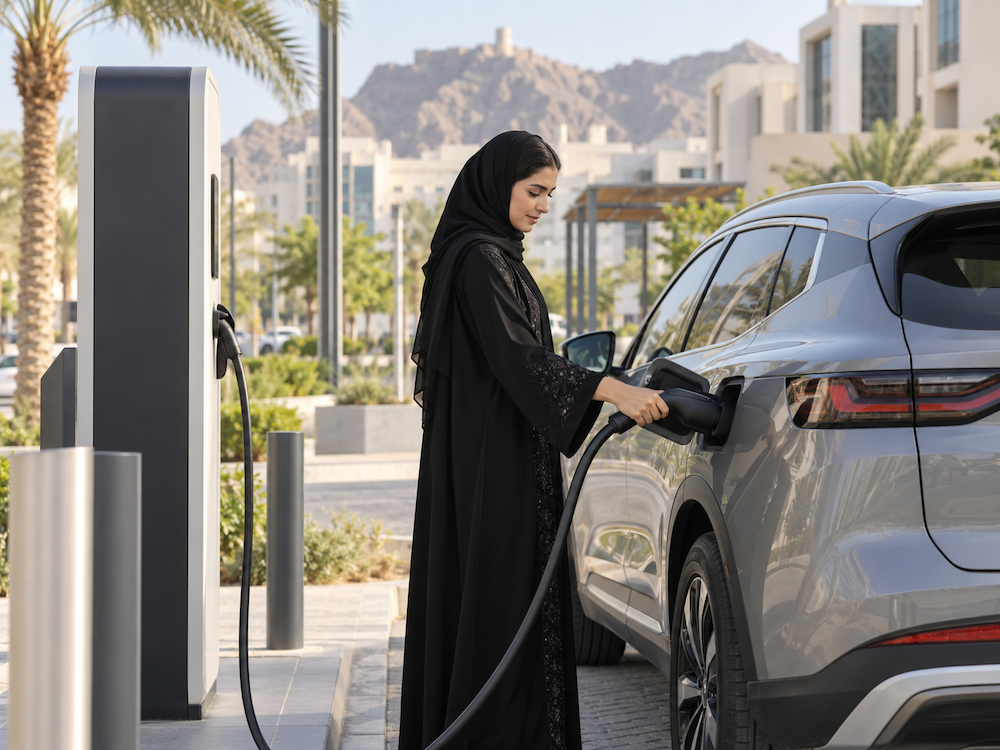
Let’s take three petrol-car scenarios:
1) Efficient petrol sedan: 6L/100km
At M95 prices: 6 × OMR0.239 = OMR1.43 per 100km
2) Typical petrol car: 8L/100km
At M95 prices: 8 × OMR0.239 = OMR1.91 per 100km
3) Larger SUV: 10L/100km
At M95 prices: 10 × OMR0.239 = OMR2.39 per 100km
The efficient-car case is not theoretical. A 2026 GCC-market Toyota Camry 2.5-litre, for example, is officially rated in Saudi Arabia at 17.2km/litre, equivalent to approximately 5.8L/100km. The Oman-market Camry uses the corresponding 2.5-litre 201hp engine and eight-speed automatic configuration.
At 5.8L/100km and OMR0.239 per litre, fuel costs approximately: OMR1.39 per 100km. And this is where the public-charging comparison becomes interesting.
At 50bz/kWh, the EV Wins Easily
A representative 18kWh/100km EV costs: OMR0.90 per 100km at a ≤90kW public charger.
Against this sits:
- Efficient petrol sedan: ~OMR1.39
- 8L/100km petrol car: OMR1.91
- 10L/100km SUV: OMR2.39
At this charging tier, the EV has a clear operating-energy advantage. It costs roughly 35% less in energy than the highly efficient petrol benchmark and more than 50% less than an 8L/100km petrol vehicle.
But at 90bz/kWh, the Race Gets Much Closer
The same EV now costs: OMR1.62 per 100km. That remains cheaper than an 8L/100km petrol car at OMR1.91, but it is now more expensive on energy than an exceptionally efficient petrol car using around 5.8-6L/100km.
This gives us a useful break-even point. At M95 costing OMR0.239/litre, an EV consuming 18kWh/100km and paying 90bz/kWh costs the same per kilometre as a petrol vehicle consuming approximately: 6.8 litres per 100km.
A petrol car using less than that can beat the EV on energy cost, but a petrol car using more than that still loses.
And at 120bz/kWh, Petrol CAN Win
At the fastest public charging tariff: 18kWh × OMR0.120 = OMR2.16 per 100km, that is:
- More expensive than the efficient petrol sedan at ~OMR1.39
- More expensive than an 8L/100km vehicle at OMR1.91
- Still cheaper than a 10L/100km vehicle at OMR2.39
The break-even petrol consumption is approximately: 9.0L/100km
In other words, when our representative EV relies entirely on a ≥181kW charger costing 120bz/kWh, any comparable petrol vehicle consuming less than approximately 9L/100km would use less money on energy.
This does not contradict the broader finding of the government’s economic study, which assessed the market under its own assumptions. It does, however, demonstrate why there cannot be one universal answer for every driver and every vehicle.
An exceptionally efficient EV consuming 13kWh/100km would cost just OMR1.56 per 100km even at 120bz/kWh, for example.
What Happens Over 20,000km a Year?
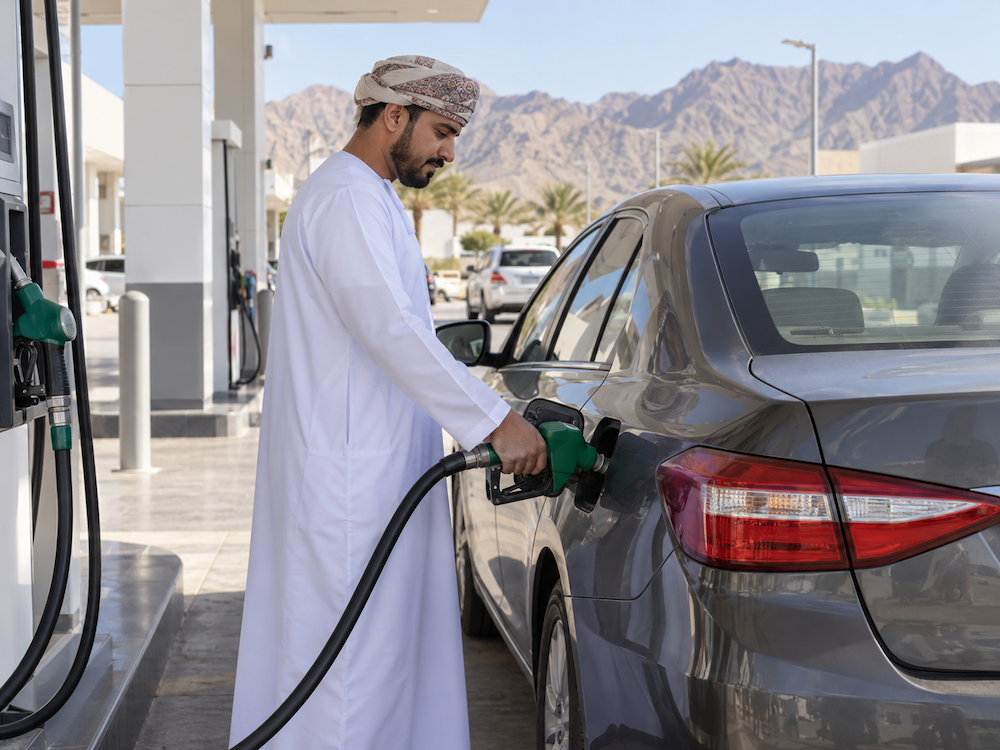
The gap becomes easier to understand when annualised. For an EV averaging 18kWh/100km and travelling 20,000km annually:
| Charging method | Approx. annual electricity cost |
|---|---|
| Home at 14bz/kWh | OMR50 |
| Home at 18bz/kWh | OMR65 |
| Home at 22bz/kWh | OMR79 |
| Home at 26bz/kWh | OMR94 |
| Home at 32bz/kWh | OMR115 |
| Public at 50bz/kWh | OMR180 |
| Public at 90bz/kWh | OMR324 |
| Public at 120bz/kWh | OMR432 |
For comparison, at M95 prices:
| Petrol consumption | Approx. annual fuel cost at 20,000km |
|---|---|
| 5.8L/100km | OMR278 |
| 6L/100km | OMR287 |
| 8L/100km | OMR382 |
| 10L/100km | OMR478 |
This produces perhaps the most important conclusion of the entire analysis. An EV owner charging at home could spend only around OMR50-115 a year on electricity for 20,000km of driving but an EV owner using predominantly 120bz/kWh public charging could spend around OMR432.
There Is Another EV Advantage: Maintenance
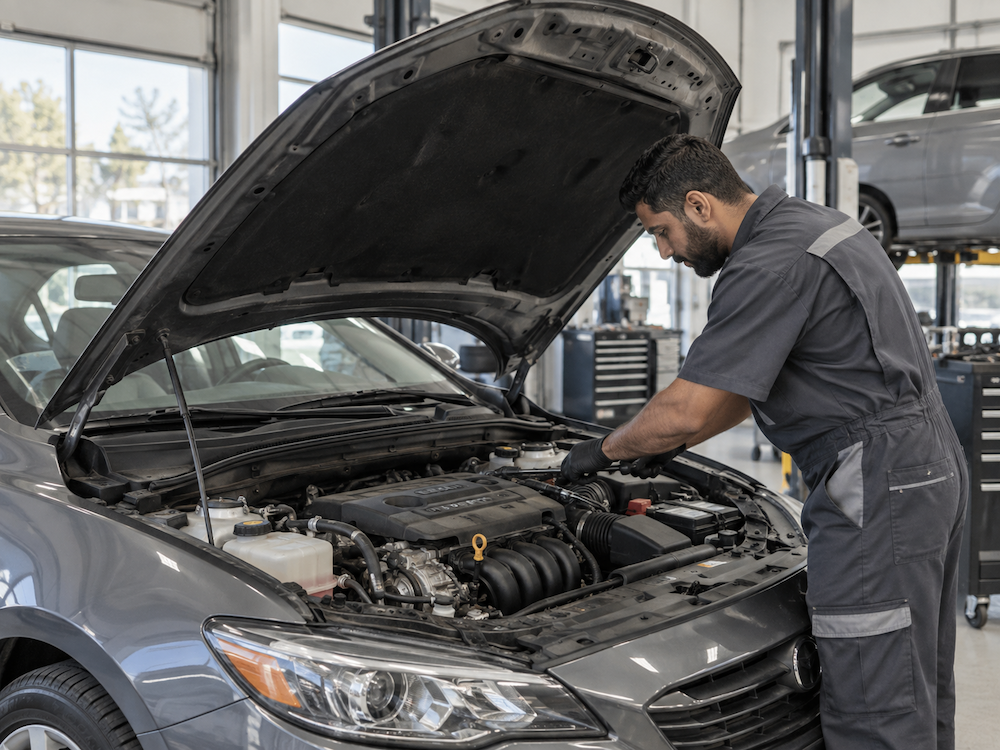
Fuel or electricity is only one element of vehicle running costs. Battery-electric vehicles also generally require less scheduled mechanical maintenance than conventional vehicles.
The US Department of Energy’s Alternative Fuels Data Center notes that all-electric cars require less maintenance because the battery, motor and power electronics require little regular servicing, there are fewer fluids to replace, regenerative braking reduces brake wear and there are substantially fewer moving components than in an internal-combustion drivetrain.
An EV does not require conventional:
- Engine oil changes
- Engine oil filters
- Spark plugs
- Engine belts
- Many engine-related gaskets and seals
- Conventional engine servicing
That does not make an EV maintenance-free. Tyres, suspension components, air-conditioning, cabin filters, coolant systems, 12V batteries and other wear components still require attention. Battery health and thermal management also become particularly important over long ownership periods.
Oman’s Climate Needs to Be Factored In
Laboratory range and consumption figures should not be treated as guaranteed Oman driving figures. High ambient temperatures increase air-conditioning demand, while battery thermal-management systems may also consume energy to maintain suitable cell temperatures.
Research by NREL highlights the significant effect of cabin cooling on electric-vehicle energy consumption and range in warm conditions. The same principle applies to petrol vehicles: hard acceleration, high cruising speeds and intensive air-conditioning can raise fuel consumption.
For that reason, OERLive’s 18kWh/100km EV scenario should be seen as an analytical benchmark rather than a promise that every EV will achieve the same figure.
Does That Mean an EV Is Cheaper Overall?
Not necessarily. Running cost and total ownership cost are different calculations, and this analysis deliberately excludes:
- Purchase price
- Financing cost
- Insurance
- Depreciation
- Resale value
- Home charger installation
- Potential battery repairs outside warranty
- Differences in tyre replacement costs
A vehicle that saves OMR200 or OMR300 annually in energy could still be more expensive over five years if its purchase price is several thousand rials higher or if depreciation is substantially greater.
Conversely, an EV purchased at a competitive price and predominantly charged at home could compound its energy and maintenance savings over several years.
The correct buying decision therefore requires looking at total cost of ownership, not simply the price displayed at the petrol pump or charging station.
Oman Is Building the Market Around This Transition
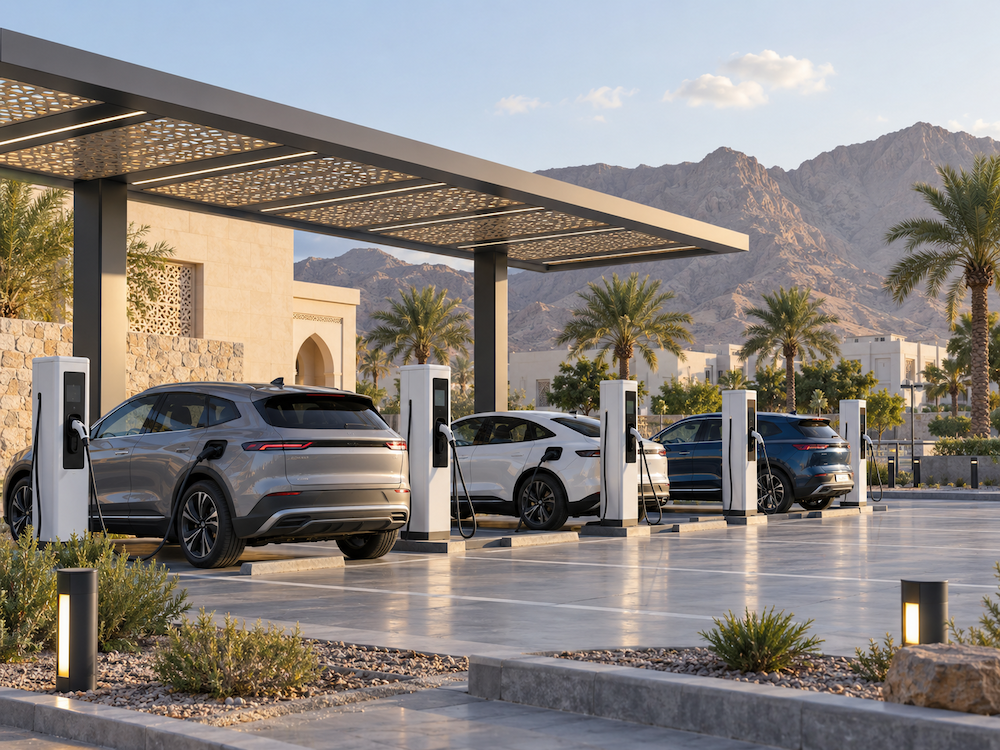
The charging tariff arrives as Oman’s EV ecosystem expands. MTCIT’s current green-mobility information shows 2,200 electric vehicles and around 160 charging stations in 2025, alongside plans to expand the national charging network. The ministry describes EV adoption as part of Oman’s broader transition toward a low-carbon transport system and its 2050 net-zero objectives.
The new national Charger App is intended to consolidate charger locations, availability, power ratings, operating times and approved fees from different providers into one interface.
That transparency will become increasingly important because charger speed will now directly affect the economics of a journey.
OERLive Verdict: Which Is Cheaper to Run in Oman?
- Home charging: EV wins by a very large margin. At standard residential electricity rates of 14–32bz/kWh, an EV can cost roughly OMR0.25-0.58 per 100km in our representative scenario.
- Public charging at 50bz/kWh: EV still wins comfortably. At around OMR0.90 per 100km, it remains substantially cheaper than most petrol alternatives.
- Public charging at 90bz/kWh: it depends. An EV still beats many conventional petrol vehicles, but a very efficient petrol sedan or hybrid can be cheaper.
- Public charging at 120bz/kWh: petrol can win. At OMR2.16 per 100km for an EV consuming 18kWh/100km, efficient and moderately efficient combustion cars can cost less to fuel.
But over normal ownership, EV maintenance remains an important advantage. For Omani drivers considering an electric vehicle, the most important question may therefore no longer be simply: “How much does an EV cost?” It may be: “Can I charge it at home?”
For a driver with reliable home charging, Oman’s electricity tariffs make the economic argument for an EV remarkably strong. But for a driver living in an apartment without private charging and relying almost exclusively on high-speed public chargers, the calculation is much closer – and at the highest charging tariff, cheap petrol can sometimes come out ahead.
Methodology note: OERLive calculations use September 2026 M95 petrol at OMR0.239/litre, the EV charging tariffs announced for October 1, 2026, and a representative EV consumption assumption of 18kWh/100km. Actual vehicle consumption varies. The published charging-tariff announcement does not state in its text whether separate VAT, parking or session charges may apply; calculations therefore use the announced per-kWh prices directly.



INVESTIGATION: Top 20 Jobs to Watch in Oman by 2030 – and What You Could Earn

National Finance & Dar Al Atta’a Renew Partnership to Empower Omani Women Through Tamkeen Beekeeping Program

VIDEO: DEEPAL Unveils New Flagship Model S09 in Oman

Win OMR 3,000: ROP & Bank Muscat Launch Cyber Fraud Awareness Short Film Competition

EXCLUSIVE INTERVIEW: Yango’s Big Vision for Oman

Leadership, Transformation Forum Reviews Inspiring Women’s Experiences

OPINION: GCC Navigates Global Macro Volatility as Worldwide Growth Moderates to 2.6%

City Centre Muscat Celebrates 25 Years of Great Moments as Mall of Oman Marks Its Fifth Anniversary

HM The Sultan Accorded Official Reception Ceremony at Windsor Castle

61.7% of Middle Eastern Families Involve the Next Generation As Business Successors or Consultants

Power And Beyond: The Path To A Low-carbon Future

Al Mouj Muscat unveils Ghadeer Villas

Time to Buy Saudi Stocks? Some Investors Look at Dubai Instead

Hospitality Industry in Oman Estimated 90% Growth in 2022

Renewables are booming, but not fast enough to cap greenhouse emissions

Retail Abu Dhabi’s ‘Unbox Amazing’ generates sales of more than AED 2 billion in participating stores

Saudis Sign Deals From Energy to Metals in Bid to Salvage Forum

Saudi Arabia’s Gold Miner Plans to Be a Global Top-20 Supplier

Technology to drive Sultanate’s downstream industry

Digitization and Logistics Service Providers Can Help SMEs Make the Most of Peak Season Retail Trends

VIDEO: Building Oman’s Future – SAH’s Vision for Infrastructure, Innovation and Growth

VIDEO: Oman Cables Breaks Ground on OMR 10 Million-Plus Plant to Power Oman’s Industrial Future

VIDEO: Hitesh Akarte on Khimji Ramdas Infrastructure’s Role in Oman Vision 2040

Oman’s Hospitality Sector Enters a New Phase of Growth: Sadiq Al Matwani Al Lawati

Amr Baabood: Oman Climate Week Is About Moving From Climate Ambition to Climate Action

Mayan Al Asfoor on Leadership, Legacy and Empowering Omani Talent

LEADERSPEAK: Dhofar Insurance CEO Sunil Kohli on Oman’s Insurance Sector, Reinsurance & Market Outlook

VIDEO: Robert MacLean on how NHI is Shaping Oman’s Next Generation of Hospitality Leaders

The Future of Oman: Decoding The Sultanate of Oman’s Strategic Promotional Nation Brand

EXCLUSIVE: AI, Robotics & Wearable Sensors are Changing the Lives of Dementia Patients
-

 Artificial Intelligence1 month ago
Top 5 Interesting Things AI Did This Month – September 2026 Edition
-

 Economy4 weeks ago
OER Magazine September Edition 2026
-

 Fashion1 month ago
Luxury Watches That Could Appreciate Over the Next Decade [2026 Auction Buyer Guide]
-

 Banking & Finance2 months ago
The GCC’s 10 Richest Billionaires: Inside US$253.5 Billion of Wealth
-

 Alamaliktistaad Magazines3 weeks ago
Alam Al-Iktisaad Magazine September 2026 Edition
-

 Banking & Finance2 months ago
INVESTIGATION: What If You Bought Apple Stock Every Time You Bought an iPhone?
-

 News2 months ago
OPEC+ Holds Output Steady for October as Focus Shifts to 2027 Quotas
-

 Artificial Intelligence1 month ago
What the World’s Top 10 Tech CEOs Really Earn