
GCC
UAE central to global movement to simultaneously harvest both food and feedstock for bioenergy
Today, the UAE imports roughly 90 per cent of its food – at a cost, that if left unchecked, is predicted to increase 300 per cent over the next decade. But the challenge of food security is also an unprecedented opportunity to advance ideas and innovations that are both sustainable and economically viable. The Masdar Institute, along with its partners, is doing just that.
“Energy, water and food security are key, interlinked needs for the UAE. Masdar Institute is committed to supporting the country’s strategic goals, and we are proud to be operating this research facility, which not only develops sustainable bioenergy and food to help fuel and diversify the UAE economy, but also serves as a training ground for a new generation of innovators,” said Dr. Behjat Al Yousuf, interim provost of Masdar Institute, a graduate research-based university in Abu Dhabi, and a founding member of the SBRC.
“This project reinforces Masdar City’s burgeoning ecosystem of innovation and strengthens its collaborative links between industry, academia and government,” said Dr Al Yousuf, “the cutting-edge bioenergy facility also provides an example of how collaboration produces real and valuable outcomes, and will thus inspire and attract further research to Abu Dhabi.”
Aquaculture – industrial fish or shellfish farming – is one of the world’s fastest expanding food sectors, with a current growth rate of about 6 per cent a year. While aquaculture systems can reduce a nation’s dependence on foreign food and improve security, they pose environmental challenges due to the impact of nutrient-rich effluents flowing into the ocean. The SBRC tackles these concerns and is seeking to minimize the footprint of commercial farming practices.
“Aquaculture systems are here to stay,” said Dr. Kevin Fitzsimmons, professor of environmental science at the University of Arizona and a globally recognized expert on aquaculture systems. “As the planet’s population approaches 9 billion people, we must advance technologies that enable sustainable and manageable food production. The innovative facility in Abu Dhabi is a showcase of how cross-sector cooperation can lead to breakthrough research with the potential to deliver both food and aviation fuel – and do so in a sustainable, scalable way,” he added.
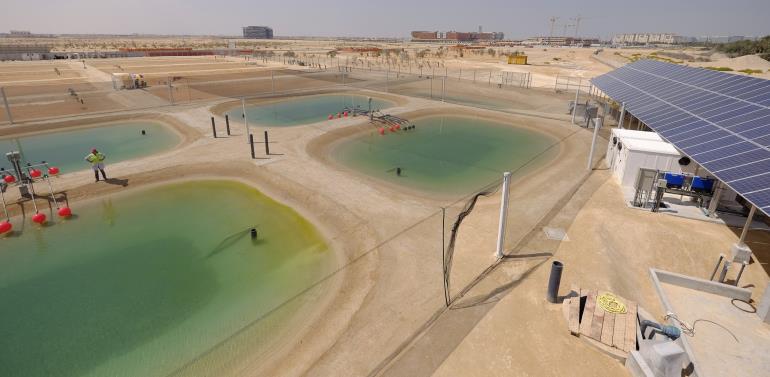
The research facility uses coastal seawater to raise fish and shrimp for food, whose nutrient-rich wastewater then fertilizes plants rich in oils that can be harvested for aviation biofuel production. The salt-tolerant halophyte plants – whose commercial potential is relatively unexplored – thrive in arid, desert conditions and don’t require fresh water or arable land to grow. In the last step of the system, wastewater is diverted into a cultivated mangrove forest, further removing nutrients and providing valuable carbon storage, before the naturally filtered and treated effluent is discharged back into the sea.
“As the global community moves toward global targets to reduce emissions, aviation too is doing its part and making great progress. Sustainable aviation biofuel is poised to play an important role in meeting the aggressive emission reduction goals industry has set,” said Marc Allen, president, Boeing International. “We’re proud to be a part of the Abu Dhabi consortium establishing this new biofuel research facility. It shows real promise to transform coastal deserts into productive farmland supporting food security and cleaner skies,” he added.
Masdar Institute, together with Etihad Airways, Boeing and Honeywell UOP, were the founding members of SBRC. TAKREER, the Abu Dhabi oil refining company, along with Safran and GE Aviation, have since joined the research group.



Win OMR 3,000: ROP & Bank Muscat Launch Cyber Fraud Awareness Short Film Competition

EXCLUSIVE INTERVIEW: Yango’s Big Vision for Oman

Leadership, Transformation Forum Reviews Inspiring Women’s Experiences

OPINION: GCC Navigates Global Macro Volatility as Worldwide Growth Moderates to 2.6%

City Centre Muscat Celebrates 25 Years of Great Moments as Mall of Oman Marks Its Fifth Anniversary

HM The Sultan Accorded Official Reception Ceremony at Windsor Castle

61.7% of Middle Eastern Families Involve the Next Generation As Business Successors or Consultants

Future Fund Oman’s $5.2B Outlook: Where Will the Sultanate’s Next Big Businesses Come From?

Oman and the UK: From Historical Legacy of Over 220 Years to Future Partnership

Sohar International Launches Expatriate Banking Proposition with Housing Loans, Cashback, Insurance & Digital Remittance Solutions

Power And Beyond: The Path To A Low-carbon Future

Al Mouj Muscat unveils Ghadeer Villas

Time to Buy Saudi Stocks? Some Investors Look at Dubai Instead

Hospitality Industry in Oman Estimated 90% Growth in 2022

Renewables are booming, but not fast enough to cap greenhouse emissions

Retail Abu Dhabi’s ‘Unbox Amazing’ generates sales of more than AED 2 billion in participating stores

Saudis Sign Deals From Energy to Metals in Bid to Salvage Forum

Saudi Arabia’s Gold Miner Plans to Be a Global Top-20 Supplier

Technology to drive Sultanate’s downstream industry

Digitization and Logistics Service Providers Can Help SMEs Make the Most of Peak Season Retail Trends

VIDEO: Building Oman’s Future – SAH’s Vision for Infrastructure, Innovation and Growth

VIDEO: Oman Cables Breaks Ground on OMR 10 Million-Plus Plant to Power Oman’s Industrial Future

VIDEO: Hitesh Akarte on Khimji Ramdas Infrastructure’s Role in Oman Vision 2040

Oman’s Hospitality Sector Enters a New Phase of Growth: Sadiq Al Matwani Al Lawati

Amr Baabood: Oman Climate Week Is About Moving From Climate Ambition to Climate Action

Mayan Al Asfoor on Leadership, Legacy and Empowering Omani Talent

LEADERSPEAK: Dhofar Insurance CEO Sunil Kohli on Oman’s Insurance Sector, Reinsurance & Market Outlook

VIDEO: Robert MacLean on how NHI is Shaping Oman’s Next Generation of Hospitality Leaders

The Future of Oman: Decoding The Sultanate of Oman’s Strategic Promotional Nation Brand

EXCLUSIVE: AI, Robotics & Wearable Sensors are Changing the Lives of Dementia Patients
-

 Artificial Intelligence1 month ago
Top 5 Interesting Things AI Did This Month – September 2026 Edition
-

 Fashion4 weeks ago
Luxury Watches That Could Appreciate Over the Next Decade [2026 Auction Buyer Guide]
-

 Economy4 weeks ago
OER Magazine September Edition 2026
-

 Banking & Finance2 months ago
The GCC’s 10 Richest Billionaires: Inside US$253.5 Billion of Wealth
-
 Alamaliktistaad Magazines3 weeks ago
Alam Al-Iktisaad Magazine September 2026 Edition
-

 Banking & Finance1 month ago
INVESTIGATION: What If You Bought Apple Stock Every Time You Bought an iPhone?
-

 News2 months ago
OPEC+ Holds Output Steady for October as Focus Shifts to 2027 Quotas
-

 Artificial Intelligence1 month ago
What the World’s Top 10 Tech CEOs Really Earn
You must be logged in to post a comment Login