
Economy
Environment Society of Oman fits two Egyptian vultures with GPS tags
The Environment Society of Oman (ESO) successfully fitted two juvenile Egyptian Vultures with solar powered GPS radio tags in January 2016 as part of research to better understand the ecology of this endangered species.
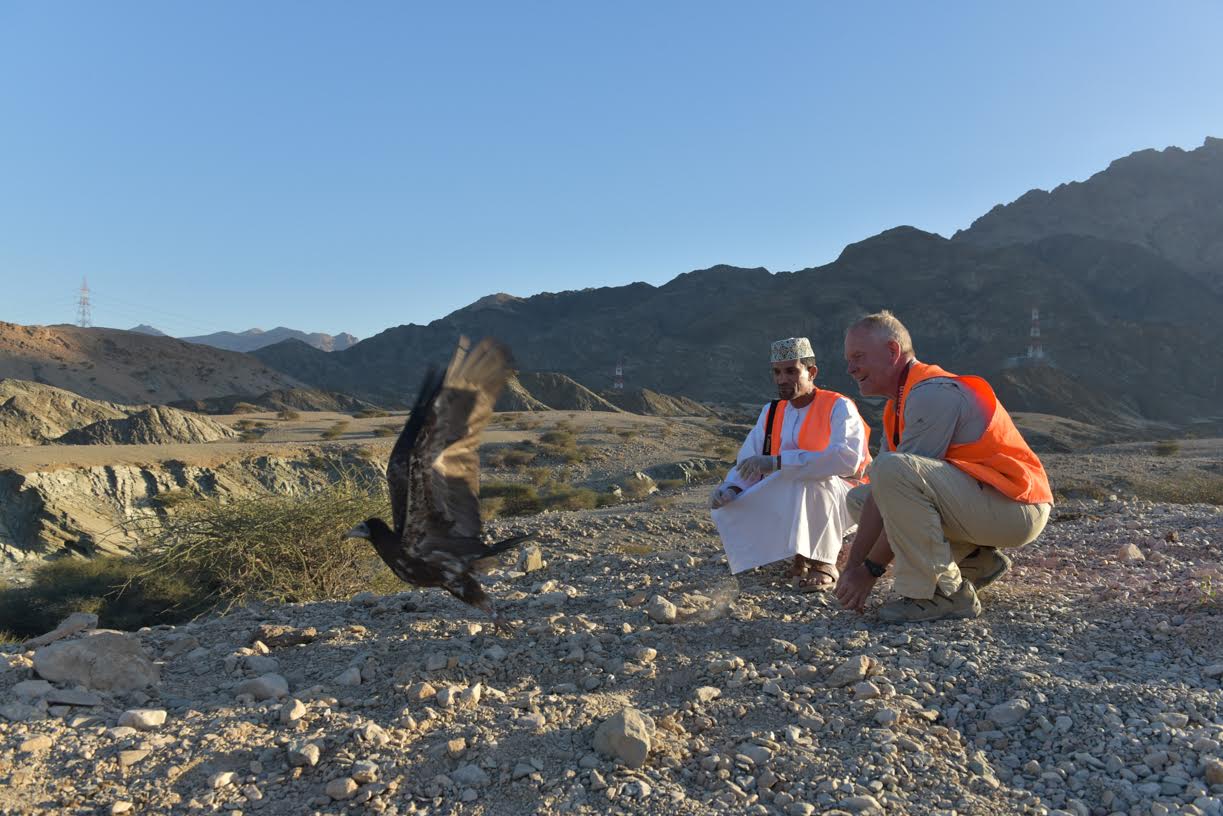
The Environment Society of Oman (ESO) successfully fitted two juvenile Egyptian Vultures with solar powered GPS radio tags in January 2016 as part of research to better understand the ecology of this endangered species. Launched as part of the Society’s Egyptian Vulture Research and Conservation project, the tracking of these birds will help us identify the birds’ habitats, important congregations, main threats, and boost conservation efforts.
On 16th of February 2016, the transmitter indicated that one of the birds had stopped moving. A team from the Environment Society of Oman visited the GPS location of the bird in Al Amerat to find a lifeless bird. There were no obvious clues as to the likely cause of death. Juvenile mortality rate in this and other birds is naturally high (70-90%). Although it may have died of natural causes, electrocution, poisoning or shooting are not to be excluded. Although gaps exist, through satellite tracking more information is being gathered on when and where these vultures move and on the causes of mortality. The second bird is still moving around northern Oman, and was most recently in the area of Tahwa, in Al Sharqiyah Governorate. The bird’s movement and updates about the project can be found at: http://egyptianvultureoman.blogspot.co.at/.
Nicknamed the “Pharaoh’s Chicken”, Egyptian vultures are distributed across southwestern Europe, northern and central Africa, Arabia, India, eastern Europe and central Asia. As a direct result of accidental and planned poisoning, electrocution on medium voltage power lines, persecution, poaching and habitat destruction, Egyptian vulture is globally endangered.
According to the International Union for Conservation of Nature (IUCN), Egyptian vulture has declined in virtually all parts of its range; experiencing a 90% decline in India during the last decade; a 50% decline in Europe over the last three generations; alongside significant declines in their African and Arabian populations. However, ESO research has shown that Oman may be a stronghold, and as such has the potential to help contribute to global conservation efforts.
Maia S. Willson, ESO Research and Conservation Manager, said: “Tracking the animal’s movement is helping us understand their habitat use and the threats to which they are exposed, whether natural or human-induced. Through satellite tracking, we were able to determine the precise location of the bird, and determine more accurately the reasons they might die. It is crucial for the tagging programme to continue, as only long-term information will enable us better understand their movements and ecology.’
Dr. Michael McGrady, Principal Investigator for the project, added: “Egyptian vultures are scavengers that provide an important ecosystem service by consuming biological waste created by humans, which provides benefits to human health and the health of domestic livestock. We want to better understand the movements of vultures in Oman and the real and potential impact of waste management and power distribution networks on vultures. Comprehensive plans for waste management and power distribution could both benefit from vulture conservation.”
ESO began researching Egyptian Vultures in early 2012, when the Society began surveying populations on Masirah Island. It has tagged four juvenile Egyptian Vultures since 2015 in collaboration with International Avian Research, revealing valuable information about Egyptian Vultures in Oman.



EXCLUSIVE: Five Innovations Developed in Oman That Deserve Attention

Oman Advances 8 Places in Innovation Inputs Pillar of Global Innovation Index 2026

OER Magazine September Edition 2026

Oman’s Hospitality Sector Enters a New Phase of Growth: Sadiq Al Matwani Al Lawati

ROHM Opens Landmark 15th Anniversary Season with its Acclaimed Production of Zeffirelli’s Rigoletto

Luxury Watches That Could Appreciate Over the Next Decade [2026 Auction Buyer Guide]

How Much Are People in Oman Saving Every Month – And What Could It Become if Invested in the MSX?

Liva Insurance Secures Three Major Honours at the Alam Al-Iktisaad Awards 2026

F5 Puts Spotlight on AI Security Innovation in Oman

bp’s New Programmes Set to Benefit Communities Across Oman

Power And Beyond: The Path To A Low-carbon Future

Al Mouj Muscat unveils Ghadeer Villas

Time to Buy Saudi Stocks? Some Investors Look at Dubai Instead

Hospitality Industry in Oman Estimated 90% Growth in 2022

Renewables are booming, but not fast enough to cap greenhouse emissions

Retail Abu Dhabi’s ‘Unbox Amazing’ generates sales of more than AED 2 billion in participating stores

Saudis Sign Deals From Energy to Metals in Bid to Salvage Forum

Saudi Arabia’s Gold Miner Plans to Be a Global Top-20 Supplier

Technology to drive Sultanate’s downstream industry

Digitization and Logistics Service Providers Can Help SMEs Make the Most of Peak Season Retail Trends
Oman’s Hospitality Sector Enters a New Phase of Growth: Sadiq Al Matwani Al Lawati

Amr Baabood: Oman Climate Week Is About Moving From Climate Ambition to Climate Action

Mayan Al Asfoor on Leadership, Legacy and Empowering Omani Talent

LEADERSPEAK: Dhofar Insurance CEO Sunil Kohli on Oman’s Insurance Sector, Reinsurance & Market Outlook

VIDEO: Robert MacLean on how NHI is Shaping Oman’s Next Generation of Hospitality Leaders

The Future of Oman: Decoding The Sultanate of Oman’s Strategic Promotional Nation Brand

EXCLUSIVE: AI, Robotics & Wearable Sensors are Changing the Lives of Dementia Patients

EXCLUSIVE: Talking Renewable Projects & Sustainability in Oman and Beyond with Vipul Tuli

VIDEO: Eng. Salim Al Thuhli, CEO, Khazaen Economic City on Investment Opportunities

H.E. Salim Al Aufi, Minister of Energy & Minerals talks about Oman’s Green Hydrogen Goals
-

 Artificial Intelligence3 weeks ago
Top 5 Interesting Things AI Did This Month – September 2026 Edition
-
 Fashion1 week ago
Luxury Watches That Could Appreciate Over the Next Decade [2026 Auction Buyer Guide]
-

 Highlights2 months ago
OERLive: Top 10 Mathematical Problems AI Has Solved or Transformed
-
 Magazines1 month ago
OER Magazine July Edition 2026
-

 Magazines1 month ago
Al Mar’a Magazine July 2026
-

 Banking & Finance4 weeks ago
The GCC’s 10 Richest Billionaires: Inside US$253.5 Billion of Wealth
-

 Alamaliktistaad Magazines1 month ago
Alam Al-Iktisaad Magazine July 2026 Edition
-

 Magazines2 months ago
OER Magazine – June 2026 Edition
You must be logged in to post a comment Login