
Experts
Innovation and Sustainability in a New Energy World
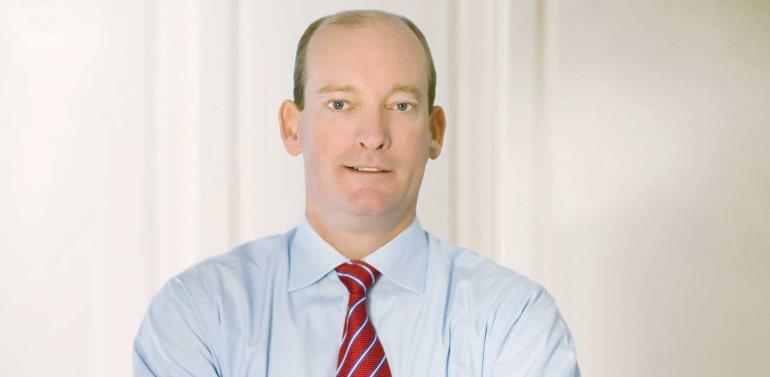
“No region is better placed than the Middle East to take advantage of the potential in greater collaboration,” said Lamar McKay, Chief Executive, Upstream, BP plc while making a presentation at the recently held ADIPEC 2015. Excerpts from his presentation:
We have seen a lot of changes over the years, including a number of price crashes. This current one has to be the fourth big fall I’ve been through in my career, so I think it’s worth looking at this assumption about a new energy world – and asking the question, “What’s different this time around?”
First of all, it’s not really demand that’s different – it’s still going the same way it’s gone for a century – and that’s up. Maybe not quite so fast as the 50-plus percentage growth over the past two decades – but it is still going up enough for us to estimate energy demand will be about a third greater by 2035 on current and expected trends. That’s driven by global population and GDP growth, with almost all of this growth stemming from developing economies, particularly China and India.
And the extra energy needed in 2035 is equivalent to about two-and-a-half times the current total energy production of the Middle East as a whole. So we are not in a new world in terms of demand. But where the picture does look different is on the supply side.
We are in a world where we are consistently finding more energy resources than we consume. Since 1980 the world has consumed around a trillion barrels of oil. But its oil reserves haven’t gone down by that amount – no – they’ve actually gone up by that volume – from 700 billion barrels to 1700 billion. That’s enough to meet over 50 years of future global production. Then we have an environment with Chinese growth softening and supply increasing – the biggest factor being 4.5 million barrels of US tight oil production a day.
Over the past 5 years – because of the shale revolution – almost two-thirds of the increase in global supplies of oil and gas has been down to the US. US tight oil may be only 5 per cent of the global oil market, but the oversupply it prompted was the key factor in driving the collapse in prices last year. So here we are in something of a new world.
Another significant change has been building for some time and that is the rising concern globally about carbon emissions and climate change. This growing sense of urgency about emissions may well translate into policies with long run implications for all fossil fuels.
In BP we see this new world as one in which prices will eventually recover, but this might take some time and prices are likely to remain volatile. That means being in good shape as businesses and as an industry to provide value at the bottom of the cycle as well as the top. With that in mind the next question is, “What does this new world really mean for those of us in International Oil Companies?”
First of all it means a big process of rebalancing, which is already well underway. Capital discipline is key to that. Across the supermajors, something like $80 billion of major projects this year have been cancelled or deferred – double that in 2013. Capex is down over $22 billion in 2015. And that combination of course has consequences for people’s jobs across the industry, as we make some difficult choices.
It is a tough time. But we are a resilient industry and a flexible one. Each company is making their own choices about where their own particular point of balance should be. For us in BP we are looking hard at a number of factors at our geographic spread of assets, at our portfolio of asset types, and at our distinctive areas of strength.
We’re very focused on capital efficiency, and looking at how we can do things differently – collaborating where we can; standardizing equipment and processes where they can bring benefits without compromising safety.
Looking around the globe, every company has its heartlands – and one of those for us is right here in the Middle East. We have a long history here and we’re very proud of that – it’s where we began as a company over a hundred years ago. We have strong roots and strong relationships here, and those are really important for us. In terms of our portfolio of assets, we look for a balance between conventionals and unconventionals; between gas and oil; and between operated and non-operated activities; and between operations that are very responsive to oil price movements and those that are less exposed – such as long term gas agreements and some PSAs.


Talabat Appoints Abdulaziz Al Haddad as General Manager to Lead tMart Oman

Al Mar’a Magazine July 2026

Alam Al-Iktisaad Magazine July 2026 Edition

OER Magazine July Edition 2026

Sohar Aluminium and OMIFCO support construction of investment building for Al Rahma Association

Sohar Port records 52% increase in port handling volume

ahlibank unites community partners to support more than 5,000 students through the 2026/2027 Back-to-School initiative

Tea and coffee imports in Oman exceed RO49 million

OERLive: Top 10 Mathematical Problems AI Has Solved or Transformed

OPINION: How AI is Redefining Work in the GCC

Power And Beyond: The Path To A Low-carbon Future

Al Mouj Muscat unveils Ghadeer Villas

Time to Buy Saudi Stocks? Some Investors Look at Dubai Instead

Hospitality Industry in Oman Estimated 90% Growth in 2022

Renewables are booming, but not fast enough to cap greenhouse emissions

Retail Abu Dhabi’s ‘Unbox Amazing’ generates sales of more than AED 2 billion in participating stores

Saudis Sign Deals From Energy to Metals in Bid to Salvage Forum

Saudi Arabia’s Gold Miner Plans to Be a Global Top-20 Supplier

Technology to drive Sultanate’s downstream industry

Digitization and Logistics Service Providers Can Help SMEs Make the Most of Peak Season Retail Trends

Mayan Al Asfoor on Leadership, Legacy and Empowering Omani Talent

LEADERSPEAK: Dhofar Insurance CEO Sunil Kohli on Oman’s Insurance Sector, Reinsurance & Market Outlook

VIDEO: Robert MacLean on how NHI is Shaping Oman’s Next Generation of Hospitality Leaders

The Future of Oman: Decoding The Sultanate of Oman’s Strategic Promotional Nation Brand

EXCLUSIVE: AI, Robotics & Wearable Sensors are Changing the Lives of Dementia Patients

EXCLUSIVE: Talking Renewable Projects & Sustainability in Oman and Beyond with Vipul Tuli

VIDEO: Eng. Salim Al Thuhli, CEO, Khazaen Economic City on Investment Opportunities

H.E. Salim Al Aufi, Minister of Energy & Minerals talks about Oman’s Green Hydrogen Goals

VIDEO: Talking Latest Developments in Aircraft Ground Guidance & More at Oman Airports

VIDEO: Dr. Firas Al-Abduwani Discusses Green Hydrogen, Potential Regions for Development & Creating a Green Ecosystem
-

 News2 months ago
INVESTIGATION: Why Nokia Could Matter More in the Quantum Age Than It Ever Did in Mobile
-

 News2 months ago
INVESTIGATION: Is AI in a Bubble? Inside the Trillion-Dollar Question Reshaping Global Markets
-
 News2 months ago
Thales & Ankaa to Deliver Multi-Mission Air Traffic Surveillance Radars for Oman, Capable of Supporting Civil & Military Operations
-
 Economy2 months ago
OMIFCO Successfully Completes Bookbuilding & Sets Final IPO Offer Price
-
 Economy2 months ago
What Higher Oil Prices Mean for Oman’s Economy in 2026
-
 Business2 months ago
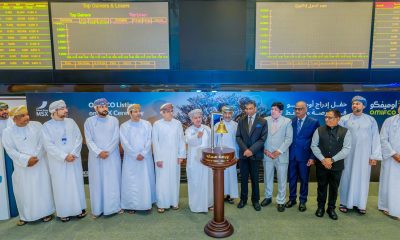
Oman India Fertiliser Company Lists on Muscat Stock Exchange
-
 Banking & Finance1 month ago
Bank Muscat posts net profit of RO137.49 million in H1 2026
-
 Insurance2 months ago
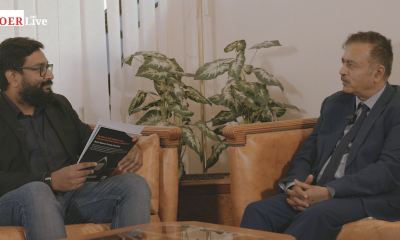
LEADERSPEAK: Dhofar Insurance CEO Sunil Kohli on Oman’s Insurance Sector, Reinsurance & Market Outlook
You must be logged in to post a comment Login