
International
Advances in extracting uranium from seawater announced
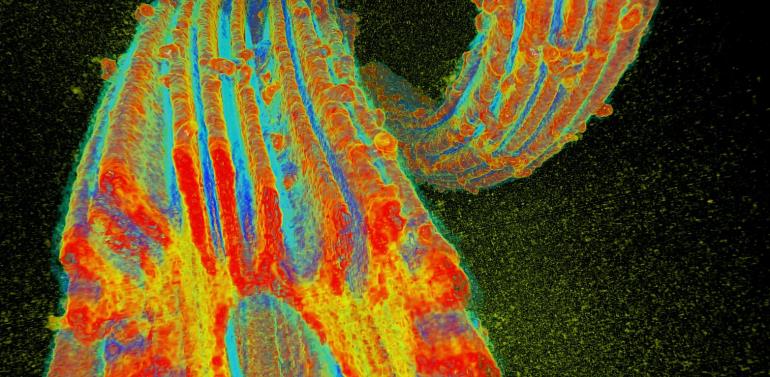
“Understanding how the adsorbents perform under natural seawater conditions is critical to reliably assessing how well the uranium adsorbent materials work,” Gill said. “In addition to marine testing, we assessed how well the adsorbent attracted uranium versus other elements, adsorbent durability, whether buildup of marine organisms might impact adsorbent capacity, and we demonstrated that most of the adsorbent materials are not toxic. PNNL also performed experiments to optimize release of uranium from the adsorbents and adsorbent re-use using acid and bicarbonate solutions.”
Marine testing at PNNL showed an ORNL adsorbent material had the capacity to hold 5.2 grams of uranium per kilogram of adsorbent in 49 days of natural seawater exposure — the crowning result presented in the special issue. The Uranium from Seawater program continues to make significant advancements, producing adsorbents with even higher capacities for grabbing uranium. Recent testing exceeded 6 grams of uranium per kilogram of adsorbent after 56 days in natural seawater — an adsorbent capacity that is 15 percent higher than the results highlighted in the special edition.
The special issue captures a wide range of enterprises, including:
Uranium coordination and computer-aided ligand design (ORNL)
Thermodynamic, kinetic and structural characterization of the adsorbent (Lawrence Berkeley National Laboratory, ORNL, PNNL)
Adsorbent synthesis using radiation to graft more polymer onto the polyethylene (ORNL, Brookhaven National Laboratory, University of Maryland)
Adsorbent synthesis using a chemical method (ORNL, University of Tennessee)
Adsorbent nanosynthesis (ORNL, PNNL, Hunter College, University of Chicago, University of South Florida, SLAC National Accelerator Laboratory, University of California-Berkeley)
Laboratory testing and modeling of adsorbent performance (ORNL, Georgia Tech)
Marine testing and performance assessment of the adsorbent (PNNL, Woods Hole Oceanographic Institution, University of Miami)
Adsorbent durability and reusability (PNNL, University of Idaho)
Adsorbent characterization, toxicity and biofouling studies (ORNL, PNNL, UI)
Technology cost analyses and modeling (University of Texas-Austin)
Green chemistry: Adsorbents prepared using marine shellfish waste (University of Alabama)
Adsorbent deployment (PNNL, ORNL, MIT)
Uranium from terrestrial sources can last for approximately 100 years, according to Erich Schneider of the University of Texas-Austin. As terrestrial uranium becomes depleted, prices are likely to rise. “If we have technology to capture uranium from seawater, we can ensure that an essentially unlimited supply of the element becomes available if uranium prices go up in the future,” Schneider said.
In July, experts in uranium extraction from seawater will convene at University of Maryland-College Park for the International Conference on Seawater Uranium Recovery. They will further explore the potential of uranium from seawater to keep the world’s lights on.



The Hidden Price of Convenience: What People in Oman Spend on Food Delivery, Coffee & Subscriptions

VIDEO: Oman Cables Breaks Ground on OMR 10 Million-Plus Plant to Power Oman’s Industrial Future

Liva Insurance Recognised for Leadership in Insurance Innovation and Digital Transformation at OERLive DX Oman

Oman Air Launches Winter Schedule with Additional Frequencies, Expanded Capacity & New Codeshare Destinations

IHE and Eicher Trucks and Buses promote school bus safety awareness among students

India’s rising edge in oil, gas and construction projects is enabling Middle East’s growth

The Financial Services Authority organises the National Health Insurance Platform Forum ‘Dhamani’

Is India’s accelerating export engine driving manufacturing towards global scale?

SAH wins double honours at Dossier Construction Awards & Summit 2026

VIDEO: Hitesh Akarte on Khimji Ramdas Infrastructure’s Role in Oman Vision 2040

Power And Beyond: The Path To A Low-carbon Future

Al Mouj Muscat unveils Ghadeer Villas

Time to Buy Saudi Stocks? Some Investors Look at Dubai Instead

Hospitality Industry in Oman Estimated 90% Growth in 2022

Renewables are booming, but not fast enough to cap greenhouse emissions

Retail Abu Dhabi’s ‘Unbox Amazing’ generates sales of more than AED 2 billion in participating stores

Saudis Sign Deals From Energy to Metals in Bid to Salvage Forum

Saudi Arabia’s Gold Miner Plans to Be a Global Top-20 Supplier

Technology to drive Sultanate’s downstream industry

Digitization and Logistics Service Providers Can Help SMEs Make the Most of Peak Season Retail Trends
VIDEO: Oman Cables Breaks Ground on OMR 10 Million-Plus Plant to Power Oman’s Industrial Future
VIDEO: Hitesh Akarte on Khimji Ramdas Infrastructure’s Role in Oman Vision 2040

Oman’s Hospitality Sector Enters a New Phase of Growth: Sadiq Al Matwani Al Lawati

Amr Baabood: Oman Climate Week Is About Moving From Climate Ambition to Climate Action

Mayan Al Asfoor on Leadership, Legacy and Empowering Omani Talent

LEADERSPEAK: Dhofar Insurance CEO Sunil Kohli on Oman’s Insurance Sector, Reinsurance & Market Outlook

VIDEO: Robert MacLean on how NHI is Shaping Oman’s Next Generation of Hospitality Leaders

The Future of Oman: Decoding The Sultanate of Oman’s Strategic Promotional Nation Brand

EXCLUSIVE: AI, Robotics & Wearable Sensors are Changing the Lives of Dementia Patients

EXCLUSIVE: Talking Renewable Projects & Sustainability in Oman and Beyond with Vipul Tuli
-

 Artificial Intelligence4 weeks ago
Top 5 Interesting Things AI Did This Month – September 2026 Edition
-

 Fashion3 weeks ago
Luxury Watches That Could Appreciate Over the Next Decade [2026 Auction Buyer Guide]
-

 Highlights2 months ago
OERLive: Top 10 Mathematical Problems AI Has Solved or Transformed
-

 Economy2 weeks ago
OER Magazine September Edition 2026
-

 Banking & Finance1 month ago
The GCC’s 10 Richest Billionaires: Inside US$253.5 Billion of Wealth
-
 Magazines2 months ago
OER Magazine July Edition 2026
-

 Magazines2 months ago
Al Mar’a Magazine July 2026
-

 Alamaliktistaad Magazines2 months ago
Alam Al-Iktisaad Magazine July 2026 Edition
You must be logged in to post a comment Login