
Cybersecurity
Oman’s Next Digital Export Could Be Cybersecurity
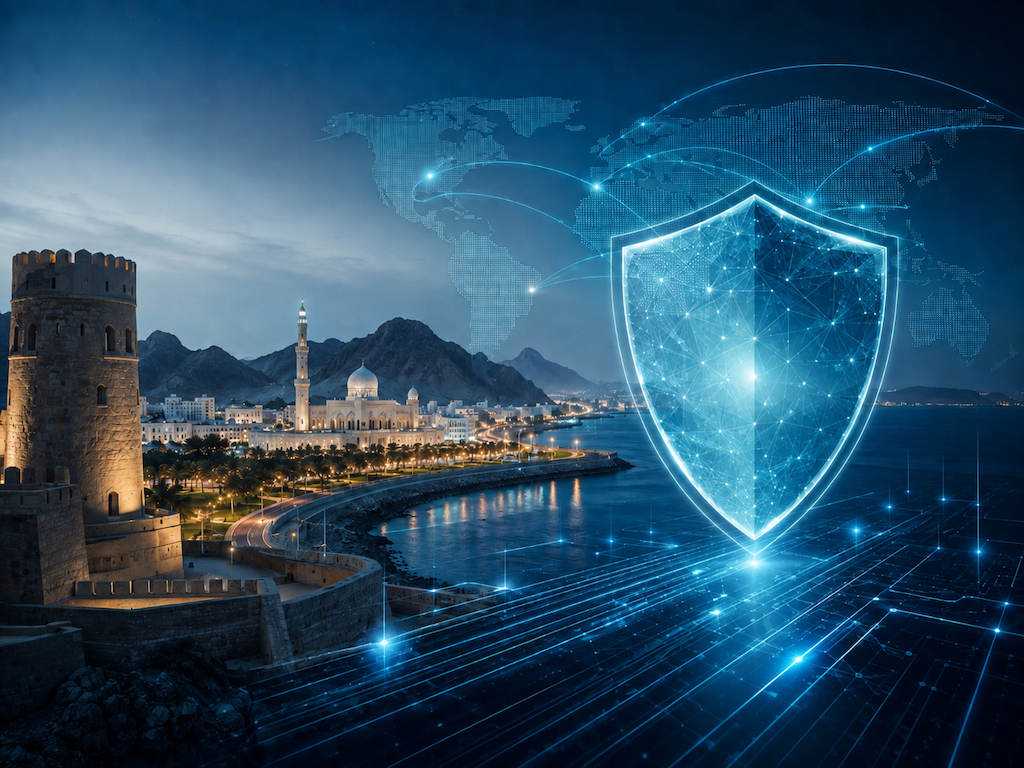
As cyber risk becomes an economic concern worldwide, the Sultanate of Oman is attempting something more ambitious than simply securing its own digital infrastructure. A growing ecosystem of local companies, Security Operations Centres, cybersecurity products and skilled professionals are laying the foundations for an industry that could eventually sell Omani expertise across the GCC and beyond.
Image courtesies and sources mentioned below
Cybersecurity rarely appears on an economy’s list of exports.
Oil, natural gas, petrochemicals, metals, logistics and tourism are easier to measure. Cybersecurity is different. Its exports may take the form of analysts monitoring networks from a Security Operations Centre in Muscat, penetration testers assessing infrastructure hundreds of kilometres away, locally developed software being deployed abroad, or consultants advising a bank, government or energy company in another market.
For Oman, that very distinction is becoming increasingly important. On July 29, 2026, the Ministry of Transport, Communications and Information Technology (MTCIT) published its Oman Cybersecurity Market and Investment Report, framing cybersecurity not simply as a requirement for protecting an increasingly digital economy, but as an economic sector in its own right.
The report estimates that Oman’s cybersecurity market will grow from approximately US$135.33 million in 2025 to US$214.27 million by 2031, representing a compound annual growth rate of 7.97 per cent. The forecast used in the report originates from Mordor Intelligence.
More important than the headline value, however, is what has been happening underneath it. According to MTCIT, the number of local cybersecurity companies increased from 16 in 2020 to 48 following the 2021–2025 phase of the Hadatha Cybersecurity Industry Programme. The number of accredited cybersecurity service providers increased from four in 2021 to 11 by the end of 2025, while 17 locally developed cybersecurity products have emerged from the ecosystem.
The interesting question now is whether Oman can turn that capability into a commercial industry capable of competing beyond its borders.
Cybersecurity becomes an industry

Cybersecurity has traditionally been viewed as a cost centre as companies bought firewalls, antivirus software, security appliances and consulting services because they had to protect themselves. Governments invested in national cyber resilience because the consequences of disruption could be severe.
But that model is changing rapidly: digitisation means almost every major industry is becoming dependent on software, cloud platforms, connected devices and digital identities. At the same time, artificial intelligence is lowering barriers for both defenders and attackers.
The World Economic Forum’s Global Cybersecurity Outlook 2026 found that 94 per cent of surveyed respondents expect AI to be the most significant driver of change in cybersecurity, while 87 per cent identified AI-related vulnerabilities as the fastest-growing cyber risk during 2025. The proportion of organisations assessing the security of their AI tools almost doubled from 37 per cent in 2025 to 64 per cent in 2026.
Traditional threats have not disappeared either. IBM’s 2026 X-Force Threat Intelligence Index reported a 44 per cent year-on-year rise in exploitation of public-facing applications, while the number of active ransomware and extortion groups observed by X-Force increased from 73 in 2024 to 109 in 2025.
What this means commercially is straightforward: more digital infrastructure creates more assets that require protection, while increasingly sophisticated threats raise the level of expertise required to protect them. Cybersecurity consequently becomes less like purchasing a piece of software and increasingly resembles an ongoing service.
That is potentially the important distinction for Oman to pursue. Mordor Intelligence estimates that services represented roughly 67.9 per cent of Oman’s cybersecurity market in 2025, while managed security services are forecast to grow particularly strongly through 2031. Cloud security, meanwhile, is projected to be among the fastest-growing deployment areas as organisations shift more workloads to cloud environments.
And these services are inherently exportable, since a cybersecurity analyst in Muscat does not necessarily need to be located in the same country as the infrastructure being monitored.
From cyber defence to cyber economics
Oman has spent several years building the institutional foundations for this transition. The Hadatha programme is explicit about its economic objective. MTCIT describes its vision as establishing a specialised cybersecurity industry capable of enhancing and diversifying economic growth. Among its strategic themes are developing specialised capabilities, supporting cybersecurity startups and SMEs, promoting Omani cybersecurity companies internationally, attracting foreign investment and, crucially, supporting the export of cybersecurity services and expertise to regional and international markets.
This fits within a much broader shift taking place in Oman’s digital economy strategy. The National Digital Economy Programme aims ultimately to increase the digital economy’s contribution to GDP to 10 per cent by 2040. The country’s digital transformation framework has also identified a goal of exporting 25 per cent of digital-economy services by 2035.
And cybersecurity could become one component of those exports. The advantage is that cybersecurity does not necessarily require the physical supply chains associated with manufacturing. Intellectual property, specialist skills and managed services can travel electronically.
An Omani managed security service provider could theoretically monitor companies in Riyadh, Doha, Dubai or Manama from Muscat. An Omani penetration-testing team could conduct assessments for clients across multiple markets; locally developed cybersecurity products could be licensed abroad; and Cybersecurity consultants could provide specialised expertise to energy, logistics and government organisations across the region.
In that sense, the raw material here is largely knowledge.
The beginnings of an export story

There is already evidence that the model can extend beyond Oman. Oman Data Park (now Otech), for example, operates a round-the-clock Security Operations Centre and markets managed cybersecurity services including SIEM, network security, vulnerability management, web application security and other monitoring capabilities. The company has previously said it serves local and international organisations and has implemented solutions in other GCC markets while seeking opportunities further afield.
Another significant development came in 2024, when Swiss cybersecurity company Dreamlab Technologies and Oman International Development and Investment Company, Ominvest, announced the merger of Dreamlab Technologies Oman and Omani cybersecurity company National Security Services Group.
The combined operation was positioned specifically as a cybersecurity provider for Oman and the wider region, combining Dreamlab’s international technology capabilities with expertise developed within Oman.
These examples are significant because they point towards two possible models for the development of Oman’s cybersecurity industry.
One is the emergence of home-grown cybersecurity service providers that gradually expand internationally. The other is Oman becoming a base where international technology and Omani expertise combine to serve regional customers.
Both will inherently generate economic value. The current MTCIT register illustrates the breadth beginning to emerge in the domestic ecosystem. Companies operating across accredited security-assessment or managed-security categories include Otech, Insight Information Security, Dreamlab Technologies, Securado, Tatweer Cyber Security, PromaSecure, InterTech, AHAT and Adeo Cyber Security, among others.
The picture is therefore broader than a handful of multinational technology vendors selling products into Oman.
Why Security Operations Centre (SOC)s matter
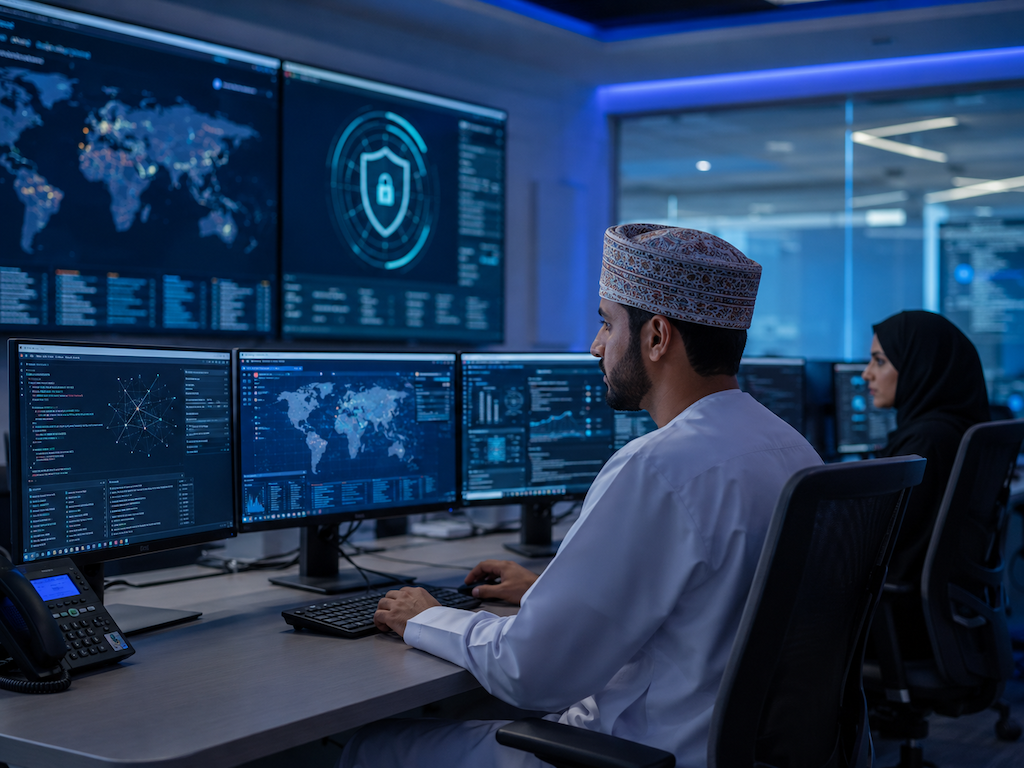
Perhaps the most important piece of this story is the humble SOC. A Security Operations Centre continuously watches an organisation’s digital environment for suspicious activity. Analysts monitor security events, investigate alerts, identify compromises and coordinate responses.
Traditionally, large organisations built their own SOCs. Increasingly, however, companies are outsourcing some or all of that function to managed-security providers.
The economics make sense: maintaining a sophisticated cybersecurity operation requires specialised people, software platforms, threat intelligence, continuous training and around-the-clock staffing.
For many organisations – particularly SMEs – building that capability independently may be difficult to justify. But a central SOC can spread those costs across multiple customers.
That same model can cross borders too as an SOC in Oman serving ten Omani companies could potentially serve customers elsewhere in the GCC without replicating the entire operation in every market. At sufficient scale, cybersecurity begins to resemble other internationally traded professional services.
Among the cybersecurity projects currently being promoted for investment is an AI-powered Security Operations Centre, designed to use artificial intelligence and machine learning to improve real-time threat detection and response while serving government entities, financial institutions, telecom operators and enterprises.
The Ministry is also separately promoting a Cybersecurity-as-a-Service platform for SMEs, encompassing monitoring, compliance tools, endpoint protection and employee training.
An Omani cybersecurity proposition
Oman will not be alone in seeing the commercial opportunity. Saudi Arabia and the UAE are investing heavily in cloud infrastructure, artificial intelligence and cybersecurity. Major international cybersecurity vendors already have significant operations across the Gulf.
The opportunity for Oman therefore may not lie in attempting to replicate every element of the global cybersecurity industry but rather in specialising in niches.
And Oman has several characteristics that could support such a strategy.
One is regulatory credibility. The Sultanate of Oman is classified in the highest Tier 1 category of the ITU Global Cybersecurity Index, while Oman hosts the first ITU Arab Regional Cybersecurity Centre. Oman National CERT has also played leadership roles in regional and Islamic cybersecurity cooperation.
The ITU index is best understood as a measure of national commitment and cybersecurity capability across areas such as legal measures, technical capacity, organisation, skills and international cooperation rather than as a measure of how frequently a country experiences cyberattacks.
The Gulf’s cybersecurity requirements are becoming more complex
Another potential advantage is proximity to industries with unusually demanding cybersecurity requirements. Oman’s economy includes oil and gas, refineries, petrochemicals, ports, logistics, banking, telecommunications and increasingly sophisticated industrial infrastructure.
Protecting these environments differs substantially from securing a normal office network. Industrial organisations operate operational technology (OT): control systems, industrial equipment, sensors and increasingly connected physical assets.
As industrial systems become more connected to enterprise IT networks and cloud platforms, cybersecurity extends beyond protecting information. It can become part of protecting physical operations.
The World Economic Forum notes that the traditional separation between IT and operational technology is becoming increasingly difficult to maintain as industrial environments become more connected. It expects cyber-physical security to gain importance as autonomous systems, robotics and connected industrial infrastructure expand.
For Oman, that could eventually produce specialised expertise that has value elsewhere.
A cybersecurity industry experienced in protecting energy assets, ports, industrial facilities or logistics networks in Oman is developing skills relevant to many of the same industries throughout the GCC.
This may offer a more defensible niche than trying to compete globally in generic consumer cybersecurity software.
Regulation creates a market
Cybersecurity demand is also increasingly supported by regulation. Oman’s Personal Data Protection Law and its Executive Regulations require organisations handling personal data to implement defined governance measures. Controllers must maintain data-processing records, establish data-protection policies and, in specified circumstances, notify both the Ministry and affected individuals of a personal-data breach within 72 hours.
Organisations are also required to appoint a Data Protection Officer in accordance with the regulations. For businesses, these rules transform cybersecurity and data governance from discretionary IT spending into a component of corporate compliance.
Banking is another important source of demand with the Central Bank of Oman’s Open Banking Regulatory Framework including explicit cybersecurity and information-security requirements, while its digital-banking framework addresses cyber-risk management as part of the operating environment for digital banks.
Thereby, every new digital bank, payment platform, government portal, cloud migration, AI application or connected industrial system potentially requires security architecture, testing, monitoring, identity management, compliance and incident response.
AI changes the equation again
The next stage may be AI-driven cybersecurity. AI is creating both a problem and an opportunity.
Attackers can use AI to accelerate reconnaissance, phishing and other parts of their operations. Enterprises, meanwhile, are embedding generative and increasingly agentic AI into their workflows, creating new questions about sensitive data, permissions and machine identities.
At the same time, defenders can use AI to analyse enormous volumes of security information far faster than human teams alone.
This is particularly significant for SOCs as a traditional SOC can generate thousands of alerts – Many of which could be harmless. But analysts must determine which deserve investigation.
Artificial intelligence can also potentially automate parts of that process, correlate events and allow human experts to concentrate on higher-value investigations.
That is why MTCIT’s proposed AI-SOC deserves attention beyond the technology itself. If Oman can build an AI-assisted cybersecurity operation combining automation with skilled analysts, its output becomes an exportable service.
Beyond AI: preparing for quantum security
Another investment opportunity being promoted is a Quantum Cybersecurity Centre in Muscat, with the Ministry outlining an estimated investment of around US$20 million over three to five years.
The proposed centre would focus on areas including quantum-resistant security and quantum key distribution as organisations begin preparing for the longer-term implications quantum computing could have for existing cryptographic systems.
Commercially viable quantum cybersecurity remains a developing field, and its trajectory will depend heavily on how quantum computing itself progresses.
If developed alongside universities, startups and commercial customers, such projects could shift parts of Oman’s cybersecurity ecosystem from implementing technologies developed elsewhere towards creating more intellectual property locally.
The human-capital question
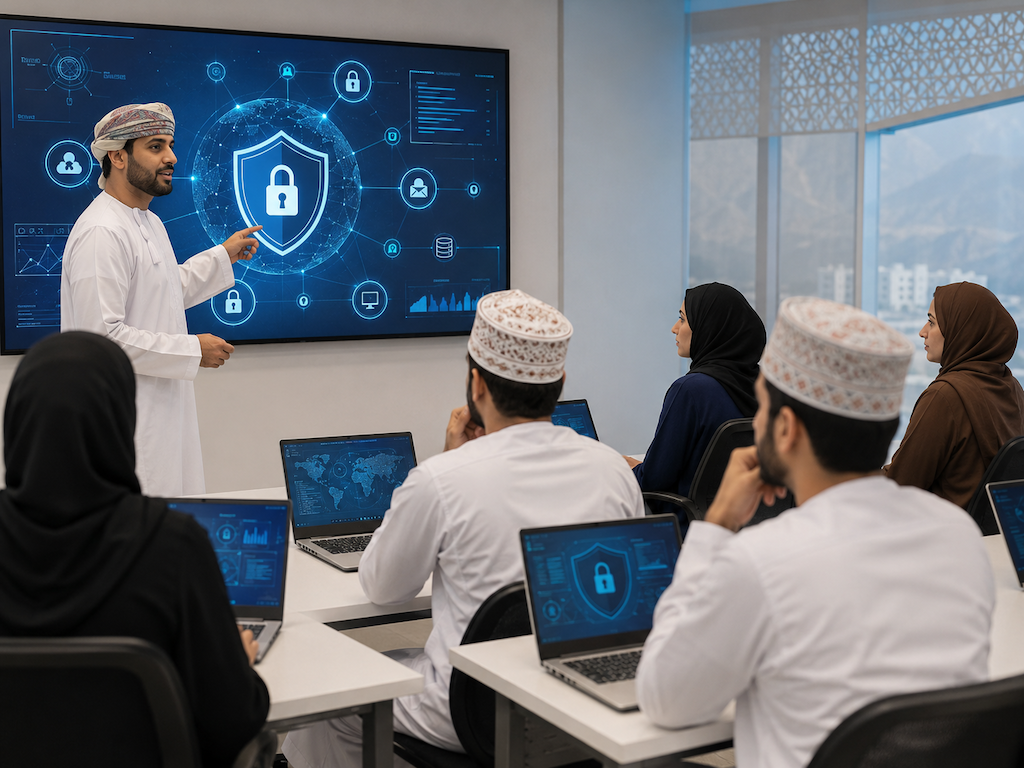
Technology alone, however, does not create a cybersecurity industry… People do.
MTCIT’s 2026 market report identifies 18 academic institutions offering cybersecurity majors, approximately 1,870 cybersecurity students, 445 jobseekers in the field and around 13,000 beneficiaries of Hadatha programmes over the previous five years.
The wider IT sector is already seeing significant localisation. MTCIT reported that Omanis represented approximately 45.5 per cent of the IT-sector workforce in 2025, rising to approximately 69 per cent in technical, specialised and leadership positions.
Universities and private companies are also beginning to build more practical cybersecurity training infrastructure.
The German University of Technology in Oman, for example, has partnered with Insight Information Security to establish an advanced cybersecurity laboratory where students can work with cyberattack simulations, incident response, vulnerability analysis and AI-related cybersecurity research.
The global cybersecurity skills discussion is shifting from simply asking how many professionals are available to whether they possess the right specialist capabilities.
For instance, the World Economic Forum found that 54 per cent of organisations identified insufficient knowledge or skills as an obstacle to implementing AI for cybersecurity. Its research also ranks networks and cybersecurity among the fastest-growing categories of skills expected through 2030.
For Oman, the next stage is therefore not only producing cybersecurity graduates. It is producing SOC analysts, incident responders, penetration testers, cloud-security architects, OT-security specialists, malware researchers, digital-forensics experts, identity specialists and eventually professionals working in fields such as AI security and post-quantum cryptography.
The opportunity in SMEs
Large banks, telecom operators, energy companies and government institutions will naturally remain major cybersecurity customers. But the most interesting growth area may ultimately be smaller businesses.
A small logistics company, retailer, hotel, clinic or professional-services company increasingly uses cloud software, digital payments, online customer accounts and connected devices.
Its cyber exposure can therefore grow considerably without the company ever becoming large enough to employ a full cybersecurity department.
That creates the market for Cybersecurity-as-a-Service. So, rather than purchasing multiple security products and employing a team to operate them, a business pays a recurring subscription to a provider that handles monitoring, endpoint protection, compliance and other functions.
A platform developed for 500 SMEs in Oman could potentially be adapted for thousands of companies across neighbouring markets – and that could turn cybersecurity from a project-based consultancy business into recurring digital revenue.
Measuring the industry will be the next challenge
One area that will become increasingly important as the sector develops is measuring its commercial performance. Market estimates provide a useful overall picture, but detailed public financial information for individual private Omani cybersecurity firms remains limited.
Many cybersecurity businesses are privately held, while larger technology companies often combine cybersecurity revenue with cloud, data-centre, telecommunications or broader ICT services.
That makes it difficult to establish publicly how much revenue Omani cybersecurity companies currently generate specifically from cybersecurity, or what proportion comes from overseas customers.
This is not unusual for an emerging technology sector, but as cybersecurity grows as an industry, metrics such as export revenue, recurring managed-security revenue, local intellectual property sales, foreign customer numbers, cybersecurity employment and private-sector investment could provide a clearer picture of its economic contribution.
Can Muscat become a regional SOC hub?
The idea is increasingly plausible and the Middle East is simultaneously becoming more digital and more conscious of cybersecurity risk. Interestingly, the World Economic Forum’s 2026 cybersecurity research found that 84 per cent of respondents in the Middle East and North Africa believed their countries were prepared to protect critical infrastructure, indicating relatively high confidence in national cyber preparedness compared with several other regions.
For Oman, the commercial opportunity may therefore be to convert institutional credibility, regional relationships and the expertise being built domestically into services.
A regional SOC hub would not require every cyber technology to be invented in Oman. It could combine internationally developed cybersecurity platforms with Omani analysts, locally developed products, Arabic-language capability, regional regulatory knowledge and specialised experience protecting industries common across the GCC.
This is similar to how successful technology ecosystems often develop: countries do not necessarily manufacture every server, processor or software platform they use. Economic value can instead be captured through integration, expertise, services, intellectual property and specialised applications.
A different kind of non-oil export
Perhaps the most interesting aspect of cybersecurity is what an export could look like.
Nothing necessarily leaves a port. There may be no container, tanker or aircraft.
An analyst in Muscat identifies an intrusion against a customer abroad. An Omani cybersecurity company licenses software to a regional organisation. A penetration-testing team assesses a foreign bank. A locally based SOC monitors customers across several countries. A cybersecurity startup sells a specialised product internationally.
Yet every one of those transactions represents exportable economic activity. That is why the next phase of Hadatha may prove more consequential than the first.
The programme’s 2026–2030 roadmap says Oman intends to move from foundational development toward measurable industrial impact, supporting scalable products, expanding national companies and helping them enter regional and international markets.
Can an Omani cybersecurity company win a major managed-security contract elsewhere in the Gulf? Can locally developed cybersecurity intellectual property find international customers? Can Muscat-based analysts protect companies across multiple markets? Can an Omani startup build a security product capable of scaling outside the Sultanate?
If the answer to those questions increasingly becomes yes, cybersecurity may begin to occupy an unusual but valuable place in Oman’s diversification story.
Not simply as the technology protecting the digital economy but as an industry within it.
*Images generated with artificial intelligence models.



IHE and Eicher Trucks and Buses promote school bus safety awareness among students

India’s rising edge in oil, gas and construction projects is enabling Middle East’s growth

The Financial Services Authority organises the National Health Insurance Platform Forum ‘Dhamani’

Is India’s accelerating export engine driving manufacturing towards global scale?

SAH wins double honours at Dossier Construction Awards & Summit 2026

VIDEO: Hitesh Akarte on Khimji Ramdas Infrastructure’s Role in Oman Vision 2040

Alam Al-Iktisaad Magazine September 2026 Edition

A decade of investing: Tech portfolio returned 1,342% versus Nasdaq-100’s 636%

His Majesty the Sultan arrives in Kazakhstan

Oman’s trade surplus reaches RO5.5 billion in July 2026

Power And Beyond: The Path To A Low-carbon Future

Al Mouj Muscat unveils Ghadeer Villas

Time to Buy Saudi Stocks? Some Investors Look at Dubai Instead

Hospitality Industry in Oman Estimated 90% Growth in 2022

Renewables are booming, but not fast enough to cap greenhouse emissions

Retail Abu Dhabi’s ‘Unbox Amazing’ generates sales of more than AED 2 billion in participating stores

Saudis Sign Deals From Energy to Metals in Bid to Salvage Forum

Saudi Arabia’s Gold Miner Plans to Be a Global Top-20 Supplier

Technology to drive Sultanate’s downstream industry

Digitization and Logistics Service Providers Can Help SMEs Make the Most of Peak Season Retail Trends
VIDEO: Hitesh Akarte on Khimji Ramdas Infrastructure’s Role in Oman Vision 2040

Oman’s Hospitality Sector Enters a New Phase of Growth: Sadiq Al Matwani Al Lawati

Amr Baabood: Oman Climate Week Is About Moving From Climate Ambition to Climate Action

Mayan Al Asfoor on Leadership, Legacy and Empowering Omani Talent

LEADERSPEAK: Dhofar Insurance CEO Sunil Kohli on Oman’s Insurance Sector, Reinsurance & Market Outlook

VIDEO: Robert MacLean on how NHI is Shaping Oman’s Next Generation of Hospitality Leaders

The Future of Oman: Decoding The Sultanate of Oman’s Strategic Promotional Nation Brand

EXCLUSIVE: AI, Robotics & Wearable Sensors are Changing the Lives of Dementia Patients

EXCLUSIVE: Talking Renewable Projects & Sustainability in Oman and Beyond with Vipul Tuli

VIDEO: Eng. Salim Al Thuhli, CEO, Khazaen Economic City on Investment Opportunities
-

 Artificial Intelligence4 weeks ago
Top 5 Interesting Things AI Did This Month – September 2026 Edition
-

 Fashion2 weeks ago
Luxury Watches That Could Appreciate Over the Next Decade [2026 Auction Buyer Guide]
-

 Highlights2 months ago
OERLive: Top 10 Mathematical Problems AI Has Solved or Transformed
-

 Banking & Finance1 month ago
The GCC’s 10 Richest Billionaires: Inside US$253.5 Billion of Wealth
-
 Magazines2 months ago
OER Magazine July Edition 2026
-

 Magazines2 months ago
Al Mar’a Magazine July 2026
-

 Alamaliktistaad Magazines2 months ago
Alam Al-Iktisaad Magazine July 2026 Edition
-

 Economy2 weeks ago
OER Magazine September Edition 2026