Economy
Future Fund Oman’s $5.2B Outlook: Where Will the Sultanate’s Next Big Businesses Come From?

As Future Fund Oman directs capital into solar manufacturing, battery materials, tourism, food production, technology and healthcare, its emerging portfolio offers a detailed view of the Sultanate of Oman’s economic priorities and the opportunities taking shape for private enterprise, export growth and local capabilities.
Across a polysilicon factory in Sohar, an organic farming expansion, a tourism investment partnership and a series of cheques written to young technology companies, Oman’s diversification ambitions are beginning to take a more tangible form. Examining these investments together reveals how the country hopes to build its next generation of businesses, with the allocation of capital offering a more useful guide to its economic priorities than broad statements about the promise of non-oil sectors.
Established under Oman Investment Authority with OMR 2 billion allocated over five years, Future Fund Oman (FFO) sits at the centre of this effort to bring additional investment into the domestic economy. Its structure directs 90% of the allocation towards substantial local projects and reserves the remaining 10% for SMEs and startups, combining support for larger businesses with financing intended to reach a wider entrepreneurial base.
Read across the disclosed portfolio, three connected ambitions emerge: to manufacture products for international markets, strengthen domestic industries serving needs such as food and healthcare, and develop technology businesses capable of improving productivity or selling beyond Oman.
This is an interpretation of the investments announced so far, rather than an official classification of the fund’s strategy, but it helps explain why industrial plants, agricultural businesses, tourism ventures and innovation facilities appear within the same programme.
Following these investments from financing agreements through development and into operations offers a closer understanding of how the fund’s capital is supporting new productive capacity, commercial activity and opportunities for Omani businesses.
How the OMR 2 Billion Fund Is Structured
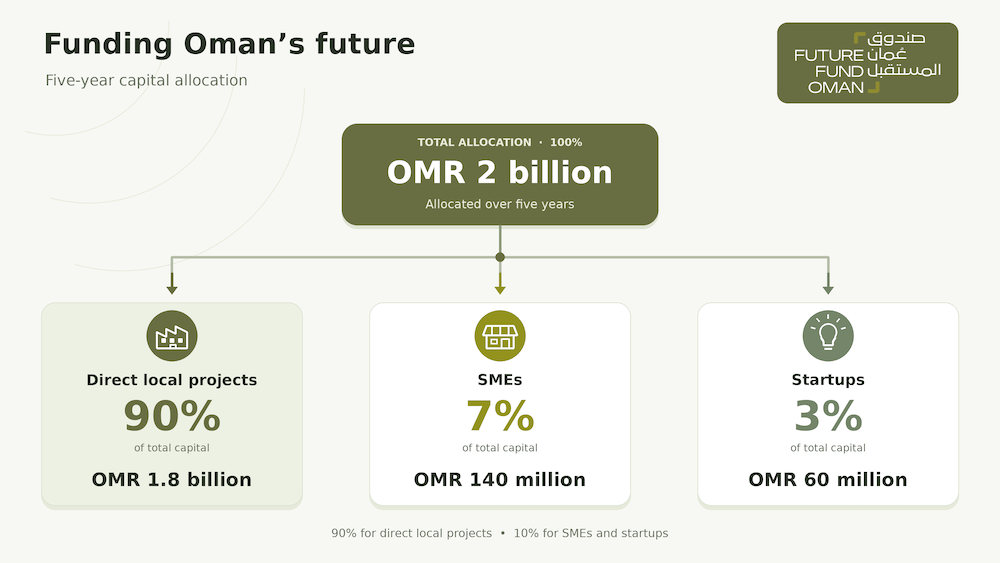

With an intended allocation of OMR 400 million annually over five years, FFO was designed to support a sustained investment programme whose largest component would finance direct local projects. The division announced at launch assigns 90% to those projects, 7% to SMEs and 3% to startups, producing the following amounts when applied to the OMR 2 billion allocation.
| Allocation | Share of FFO capital | Five-year amount |
|---|---|---|
| Direct local projects | 90% | OMR 1.8 billion |
| SMEs | 7% | OMR 140 million |
| Startups | 3% | OMR 60 million |
| Total | 100% | OMR 2 billion |
By placing OMR 1.8 billion within the direct-project allocation, the structure makes sizeable productive investments the principal route through which FFO intends to influence the economy. Financing startups remains an important part of the programme, although its scale should be understood within that wider allocation, just as the OMR 2 billion headline should be understood as capital earmarked over time rather than money already spent.
Under the published conditions on Gov.om, local projects are subject to a target investment range of OMR 5 million to OMR 100 million, maximum participation of 40% at equity or enterprise-value level, and a target return of 12%. Opportunities with lower anticipated returns may be considered where their economic impact is significant, while oil, gas and real estate are excluded under the published sector conditions.
For businesses seeking investment, these conditions create a balance between demonstrating their contribution to Oman and presenting a commercial case capable of attracting capital on credible terms. Employment, exports and technology transfer can strengthen that case, but customers, competitive costs and cash generation remain necessary to sustain it; similarly, the 12% target describes an investment-selection objective.
Because FFO operates within a larger sovereign institution, its results also need to be distinguished from those of OIA’s National Development Portfolio, which holds domestic state-owned businesses, and its internationally invested Generations Portfolio.
Within OIA’s wider investment structure, FFO has a distinct role alongside the National Development Portfolio, which holds domestic state-owned businesses, and the internationally invested Generations Portfolio. The investments discussed here relate specifically to FFO and its disclosed partnerships.
Bringing Local and International Capital Together
According to an official government update published in June 2026, FFO had approved 186 projects by the end of 2025 with an estimated combined value of OMR 1.7 billion. The update placed the fund’s own contribution at approximately OMR 640 million, reported around OMR 743 million in foreign investment and recorded 986 applications received since launch, providing a substantial year-end baseline for assessing the programme.
The reported OMR 640 million contribution is equivalent to 32% of FFO’s five-year allocation, measured on an approved-investment basis. Disbursements and project implementation follow their respective schedules, while the combined project value also includes financing from other investors.
A subsequent package reported by Oman News Agency on 9 June 2026 comprised agreements for 105 projects worth OMR 583 million, including OMR 225 million in FFO commitments. The balance consisted of OMR 176 million in local investment and approximately OMR 182 million in foreign investment, showing how the fund’s contribution was intended to sit alongside capital from other sources.
| June 2026 package | Reported amount |
|---|---|
| FFO commitments | OMR 225 million |
| Other local investment | OMR 176 million |
| Foreign investment | OMR 182 million |
| Total project and investment value | OMR 583 million |
Within the June package, each OMR 1 committed by FFO was accompanied by approximately OMR 1.59 from other investors, bringing the combined financing to OMR 2.59. This illustrates the participation of local and international capital alongside the fund. These figures describe the package’s financing composition and are presented separately from the earlier year-end totals, as the available disclosures do not establish whether the two sets overlap.
Solar Manufacturing

Among the investments disclosed so far, United Solar provides one of the clearest examples of how FFO can combine sovereign equity with international and domestic financing to support a manufacturing business. Its polysilicon project in Sohar places Oman within the supply chain for solar panels, producing a high-purity material for an industry whose customers and commercial prospects extend far beyond the domestic market.
In January 2026, United Solar reported that an investment of approximately US$260 million, equivalent to about OMR 100 million, had made FFO its largest shareholder. The company also announced US$480 million in term debt from International Finance Corporation (IFC) and partner banks, alongside more than US$400 million in local-bank term debt and working-capital facilities led by Sohar International; these amounts represent different financing components and should not be treated as separate project valuations.
By June, the company was reporting that its Sohar Freezone facility had begun operations in January 2026 and was expected to reach its annual capacity of 100,000 tonnes by year-end. Its update also announced the financial close of IFC’s US$50 million equity investment, completing an approximately US$1.6 billion capital raise, although the operating start remains a company-reported milestone and the year-end capacity figure remains a target.
Alongside the company’s account, IFC’s investment database records approval in August 2025, signing in January 2026 and an invested milestone in June 2026, together with advisory work addressing financing and environmental-management gaps. That financing trail provides evidence of implementation beyond an initial announcement, while IFC’s estimate that full-capacity output could support around 40 gigawatts of solar-module production annually indicates the project’s potential downstream significance.
The estimate concerns the manufacturing supported by its material, rather than electricity generated at the Sohar plant.
The possibility of extending this activity into a broader manufacturing chain was evident at the June 2026 FFO showcase, where an Orion Solar executive outlined a six-gigawatt solar-cell facility and a planned three-gigawatt module plant. OPAZ’s April 2026 magazine identifies Orion Solar as formerly JA Solar, a detail that helps readers connect successive announcements without mistakenly counting a renamed project twice.
Taken together, these investments suggest an effort to connect upstream materials with downstream manufacturing while creating demand for maintenance, specialist transport, quality testing, packaging and workforce training. Those supporting opportunities are an analytical implication of the projects, rather than evidence that contracts have already been awarded in every category, but they illustrate how an industrial investment could create commercial activity beyond the factory itself.
The Commercial Side of Clean-Energy Opportunities
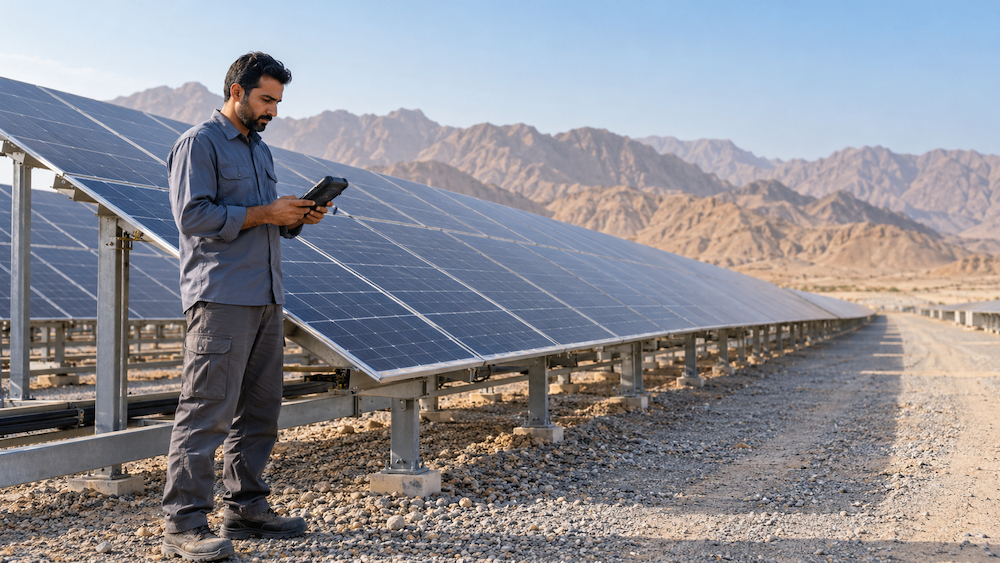
Oman’s entry into solar manufacturing comes as worldwide installations continue to expand, alongside strong competition among producers. International Energy Agency (IEA) PVPS’s September 2026 report estimates that approximately 690 gigawatts of photovoltaic capacity were installed globally in 2025, while identifying continued manufacturing overcapacity and pressure on prices and profitability.
For emerging producers, long-term competitiveness rests on efficient operations, consistent product quality, customer qualification and durable commercial relationships. These factors provide the foundation for translating manufacturing capacity into sustained sales across international markets.
Environmental and social management also forms part of project development. International Finance Corporation (IFC) classifies United Solar’s project as Category A.
Battery Materials

Within the battery supply chain, OIA’s July 2026 portfolio release identifies the Gallant Industrial Project as a planned producer of 66,000 tonnes annually of lithium iron phosphate cathode material. Local reporting also renders the name as Jalant and places the project in Salalah, describing an investment in a specialised battery input rather than a completed vehicle or battery-pack factory.
Investment in cathode materials offers Oman a potential entry point into battery supply chains serving several international markets, without requiring a domestic automotive manufacturing base. Developing this position involves consistent production quality, customer approvals, reliable inputs and competitive supply agreements, alongside responsiveness to changes in battery technology and pricing.
The need to follow projects beyond their initial announcements is illustrated by Gujarat Fluorochemicals, whose chief executive participated in the June FFO showcase before reporting a change in plans during the company’s 12 August 2026 earnings call.
Why FFO Is Working Through Specialist Investment Funds
Through partnerships with specialist investment managers, FFO is seeking access to industrial relationships, investment expertise and operating capabilities that can help bring businesses into Oman alongside capital. One example is the Energy Transition Fund announced with Templewater in July 2025, which had US$200 million in initial capital split equally between the partners and identified energy storage, clean molecules, e-fuels, smart mobility, renewable energy and green data centres as areas of interest. FFO’s commitment was consequently US$100 million within the larger vehicle.
Government reporting has also described the US$200 million IDG Oman Fund and US$250 million eWTP Oman Fund as vehicles intended to invest within Oman, covering technology, renewable energy and other industries. eWTP’s stated interests include tourism and agriculture, showing how the partnership approach extends across several parts of the diversification agenda rather than serving a single industrial segment.
For companies that already possess technology, customers or manufacturing experience, such partnerships can offer a route into Oman supported by investors with relevant knowledge and commercial networks. Assessing the resulting investment requires care, however, because FFO’s commitment to a vehicle, the vehicle’s total size, capital called from its investors and money received by an operating company represent different stages of the same financing chain. Treating each stage as a separate addition to economic investment would overstate the result.
Tourism

In tourism, FFO’s disclosed investments combine destination development with businesses that could improve the industry’s access to visitors, distribution channels and commercial expertise. The portfolio includes the As’ Sodah, or Al Sawda, Island Resort in the Hallaniyat Islands, described as extending across approximately 10 kilometres of coastline and offering a potential base for accommodation, marine transport, excursions and supporting services.
How much value a destination retains within Oman depends on the organisation of those activities, including the length of visitors’ stays, their spending and the extent to which procurement reaches domestic businesses. A resort can create demand for food, transport and maintenance, although the wider economic contribution will depend on whether capable local suppliers and operators are able to participate.
Beyond financing accommodation, an international tourism investment partner can potentially connect Omani operators with overseas customers, distribution networks and management capabilities, creating value if those relationships strengthen businesses and increase visitor expenditure.
At the entrepreneurial end of the sector, Cyfr Capital’s August 2026 investment announcement included Darrbak, a booking platform for tourism experiences that points towards the commercial opportunity in making local activities easier to discover and buy. The same group of investments included Sooq Cars, iO Eats, Decoil and Pack’N, covering vehicle commerce, food delivery, data and AI services, and packaging, although individual investment amounts were not disclosed.
Food and Agriculture
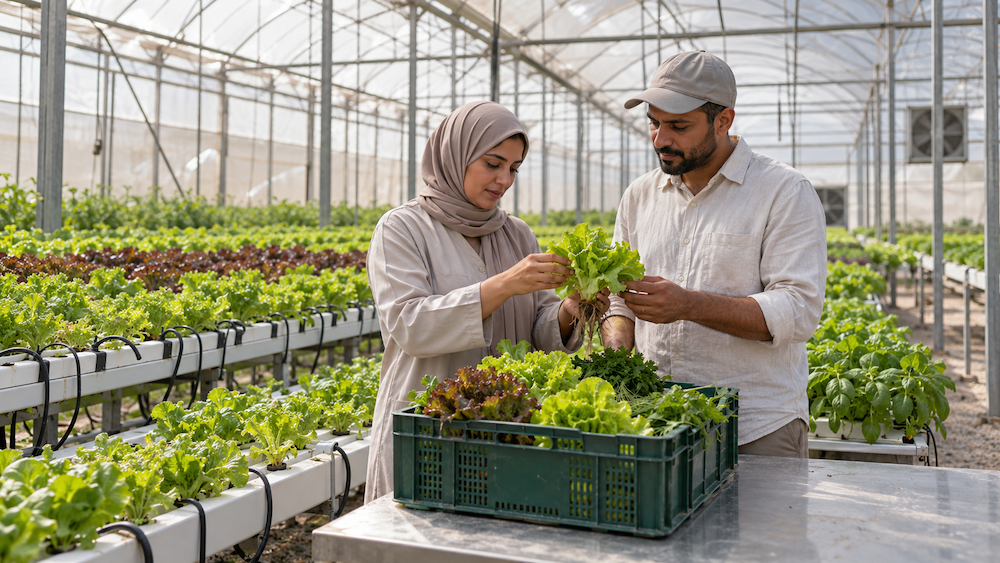
Across food and agriculture, the portfolio shows an interest in strengthening domestic production while also improving the businesses that connect producers with hotels, restaurants, retailers and consumers. OIA identifies § as an FFO investment expanding the production of more than 40 varieties of organic crops, with customers spanning those channels and offering several routes through which local agricultural output can reach the market.
Reporting in August 2026 placed FFO’s investment in Yuzu at OMR 2.1 million within an OMR 4.3 million project. The planned expansion would increase cultivated operations from four hectares to more than 40, supporting the company’s ambitions to serve a broader customer base as additional production comes on stream.
The relationship between farming and tourism illustrates how investments in separate sectors could support one another, as hotels buying Omani produce retain more supply expenditure locally while providing farmers with potentially consistent customers.
Similar links can connect growers with caterers and supermarkets, provided quality, delivery and pricing meet commercial requirements. Evaluating food security also requires attention to water use, energy consumption, storage losses and imported inputs, since higher domestic output is most useful when the underlying supply remains resilient and economically workable.
Elsewhere in the food economy, the disclosed portfolio includes Alma, an animal-nutrition company planning a manufacturing and research centre with annual capacity of 12,000 tonnes. Its inclusion points towards opportunities in production inputs and higher-value products, extending the investment agenda beyond growing food to the businesses and research capabilities that support the wider sector.
Through IO Kitchens, the portfolio also reaches the organisation of food preparation and consumer demand, with Tanmia reporting investment through the Tanmia Small-Cap Fund launched with FFO. A US$2.8 million funding round was led by that fund alongside other investors, while a partnership with Al Meera supported a multi-brand outlet in Al Amerat; the round’s total should therefore be distinguished from FFO’s individual contribution.
By improving how kitchens, brands, ordering systems and distribution work together, such businesses can potentially expand market access and make existing operations more efficient. Their commercial performance will still depend on repeat customers, margins and the cost of fulfilling orders, making operating efficiency a more useful measure of success than the sophistication of the technology alone.
Technology

Alongside investments in young Omani firms, FFO’s technology portfolio reflects an effort to bring established capabilities into the country and create places where new businesses can develop. XCyber, included through the ewpartners – FFO partnership, represents an interest in cybersecurity services for critical infrastructure, while Terminal 11 adds an innovation hub intended to connect founders, investors and research activity.
In ewpartners’ account of its relationship with OIA, the local FFO partnership is intended to bring products, technology and industrial capabilities from established markets into businesses serving Oman. Its stated interests include advanced manufacturing, ICT, renewable energy, logistics, tourism and agriculture, suggesting that technology investment is also being approached as a means of strengthening activity across other industries.
These relationships offer a pathway to develop engineering teams, product capabilities and sustained customer relationships within Oman, with the potential for businesses to serve regional and international markets over time.
Terminal 11 provides a reported operating milestone in this effort, with Cambridge Innovation Center (CIC) stating in July 2026 that the Muscat hub had opened and member move-ins were underway. CIC’s advisory engagement, beginning in June, covers operations, programming and management support, with the organisation describing its role as transferring knowledge and tools to the local team.
Healthcare

Through healthcare, FFO is pursuing opportunities in both domestic service provision and specialist industry, including a Healthcare Investment Fund announced with OMR 50 million in capital and investment in life-sciences specialist Vivo Capital. Reporting on the portfolio described OMR 77 million for Vivo, although the disclosures reviewed do not provide a project-level breakdown yet.
Albeit, alongside Alwajer Pharmaceuticals, the disclosed portfolio includes a specialist women’s healthcare development, with a September report identifying the Maternal and Fetal Care Center as an FFO-backed project intended to combine specialised care with advanced medical technologies. These investments address different parts of the sector, ranging from the potential to manufacture products to the expansion of treatment capacity and skilled employment.
Because pharmaceutical manufacturing and specialist care have different commercial models, their results need to be assessed through the approvals, quality standards, utilisation and financial performance relevant to each activity.
SMEs and Startups

Within the OMR 200 million reserved for SMEs and startups, the economic opportunity extends beyond the growth of individual recipients to their ability to supply, distribute or service the larger businesses being financed. Understanding that part of FFO requires closer attention to the different funding channels and to the distinction between money approved, committed and actually deployed.
OIA’s 17 December 2025 release provides one of the more useful snapshots, reporting 132 approved SME and venture-capital projects, US$56.7 million committed and US$37.4 million deployed through eight vehicles. The latter two amounts are approximately OMR 21.8 million and OMR 14.4 million respectively, placing deployment at about two-thirds of commitments at that reporting date without establishing the position in October 2026.
Evidence of lending reaching operating businesses also appears in Beehive’s November 2025 announcement that its SME portfolio with FFO and Sohar International had deployed more than OMR 7.1 million. Because this is a programme-level figure, it cannot safely be added to OIA’s broader SME deployment total without checking whether the same lending has already been included.
For an established company with predictable sales, debt may provide a suitable route to expansion, while a young technology business may need equity capable of absorbing a longer and less certain development period. The published Gov.om ranges reflect these different entry points, which should be assessed according to the needs of the business rather than treated as interchangeable sources of funding.
| Funding route | Published requirement range |
|---|---|
| SME equity | OMR 250,000 to 5 million |
| SME debt | OMR 100,000 to 500,000 |
| Venture investment at ideation stage | OMR 4,000 to 40,000 |
| Venture investment at pre-seed or seed stage | OMR 20,000 to 100,000 |
Under the published SME criteria, applicants must be operating businesses recording revenue and holding an SME card (Riyada), with feasibility studies also required as part of the programme conditions. Meeting those requirements does not guarantee financing, making the practical task for entrepreneurs one of identifying the appropriate route and demonstrating demand, a capable team and a credible use of capital.
Where Other Omani Businesses Could Benefit

For businesses outside the immediate list of investment recipients, FFO’s wider significance may lie in the commercial demand generated by new factories, tourism operations, farms and healthcare facilities. The opportunities below are analytical implications of the disclosed investments rather than confirmed procurement contracts, but they indicate where existing Omani companies could find room to expand.
| Investment activity | Potential opportunities for other Omani businesses |
|---|---|
| Solar and advanced-materials manufacturing | Maintenance, testing, industrial services, packaging and specialised transport |
| Tourism destinations and travel businesses | Excursions, marine services, food supply, booking systems and local experiences |
| Farming and food production | Storage, processing, packaging, distribution and resource-efficiency services |
| Healthcare and pharmaceuticals | Laboratory services, equipment maintenance, specialist training and distribution |
| Cybersecurity and technology businesses | Implementation, technical support, product development and professional training |
Where a larger investment creates dependable demand for smaller suppliers, the two parts of FFO’s mandate could reinforce one another by supporting growth while improving the competitiveness of the wider supply chain. Realising that outcome will require suppliers to understand upcoming requirements, qualify through proportionate processes and receive payment on terms they can sustain, with training linked to realistic opportunities for contracts or employment.
By investing alongside private capital, FFO has an opportunity to support additional productive capacity and broaden participation across the domestic economy, with benefits extending through suppliers, service providers and specialist businesses.
Jobs and Local Content
Employment and skills development form an important part of the programme’s potential economic contribution. The June 2026 package was associated with 2,302 planned jobs, with 568 reported as already filled at the time of the announcement.
As projects develop, opportunities can extend across construction, permanent operations, technical services and management. Training, career progression and participation by Omani professionals can help translate these investments into lasting domestic capabilities.
Local procurement offers a complementary route to economic value through the work undertaken in Oman, including processing, maintenance, logistics and specialist services. Together, workforce development and stronger supplier relationships can broaden the domestic benefits of investment.
When measuring local content, expenditure through an Omani supplier also needs to be examined for the value actually created within the country through labour, processing, services and business margins.
What Would Make the OMR 2 Billion Bet Succeed?
Across its disclosed investments, Future Fund Oman provides an increasingly detailed picture of the businesses the Sultanate of Oman is seeking to develop: manufacturers connected to international supply chains, domestic producers and service providers, and technology companies with the potential to serve wider markets.
The programme’s significance lies in the relationships these investments can create between capital, expertise, productive assets and local enterprise. As projects advance, opportunities for suppliers, entrepreneurs and skilled professionals could help extend their contribution across the economy, supporting the diversification ambitions at the heart of Oman Vision 2040.
Reporting note: This article draws on public government releases, investor and company disclosures, financing records and attributed news reporting available by 20 October 2026. Company operating claims have not been independently audited here; announced capacity, planned jobs and investment commitments are distinguished from reported operating or deployment milestones. Currency conversions are approximate.