News
Jensen Huang Resigns as NVIDIA CEO Amid Scandal, Shaking Global AI Industry

NVIDIA’s billionaire co-founder Jensen Huang has stepped down after 33 years at the company, following revelations about his personal relationships and national security concerns, triggering a sharp sell-off in the chipmaker’s shares.
In one of the most dramatic leadership changes in the technology industry, Jensen Huang has resigned as President and Chief Executive Officer of NVIDIA, bringing an abrupt end to his 33-year leadership of the semiconductor giant that helped power the global artificial intelligence revolution.
The company confirmed on Thursday, November 12, 2026, that Huang had also resigned from its Board of Directors, effective immediately. Chief Financial Officer Colette Kress has been appointed interim CEO, while Harvey C. Jones, a technology industry veteran and former Synopsys chief executive, has become NVIDIA’s first-ever Chairman of the Board.
The announcement follows several days of intensifying scrutiny surrounding Huang’s personal conduct, including reports of extramarital relationships and allegations involving a businesswoman suspected by US authorities of having connections to Chinese intelligence.
Although NVIDIA has not publicly specified the reasons for Huang’s resignation, the controversy has raised significant questions about corporate governance, national security and the future leadership of one of the world’s most valuable companies.
The Scandal Behind the Resignation

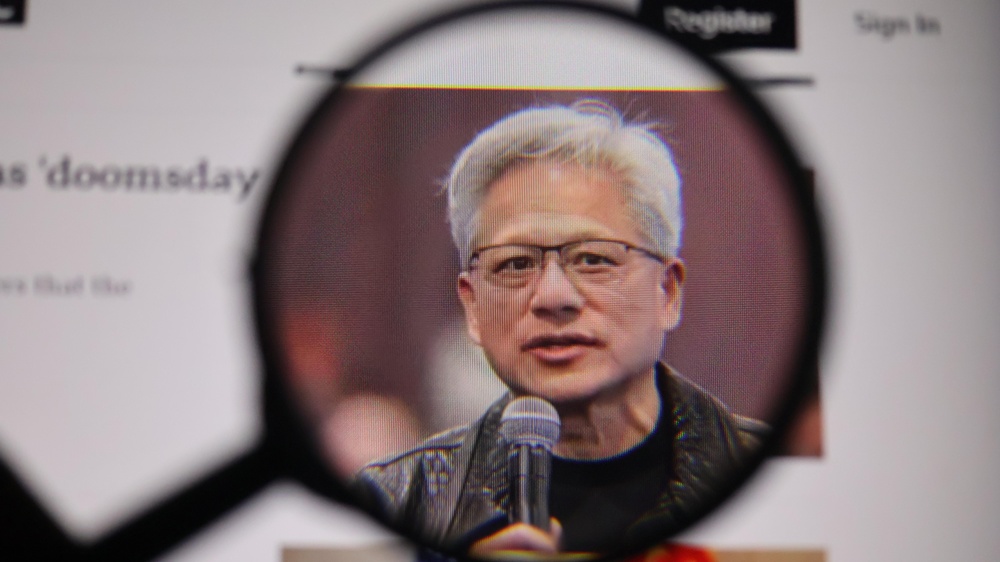
Editorial credit: favoritesphoto/Shutterstock.com
The controversy surrounding Huang intensified in early November after reports emerged of his relationship with Alice Huang, a Chinese businesswoman and former executive associated with Singapore-based cloud computing company Megaspeed International.
According to Reuters, US authorities suspect Alice Huang of having links to Chinese intelligence. Megaspeed has separately faced scrutiny over allegations involving the movement of advanced AI chips to China despite American export restrictions. Beijing has denied the espionage allegations.
The situation became particularly sensitive because NVIDIA’s advanced semiconductors are considered strategically important to US technological competitiveness and national security.
On November 8, Huang publicly acknowledged having been unfaithful to his wife in an extraordinary message to NVIDIA employees, accepting responsibility for his personal conduct and apologising to his family, colleagues and shareholders.
In the same message, he pledged to cooperate with an independent investigation initiated by NVIDIA’s Board of Directors into concerns that he may have been targeted by a foreign intelligence operation.
The Board initially expressed confidence in Huang, stating that it had no reason to believe NVIDIA’s confidential information or US national security had been compromised.
However, the controversy escalated further when The New York Times reported allegations of another relationship involving Kimberly Powell, a senior NVIDIA executive who reported to Huang.
The Board subsequently considered his future at the company, culminating in Thursday’s resignation. The existence of an investigation does not establish that espionage occurred or that confidential information was compromised.
A $4 Trillion Technology Empire Faces Uncertainty
For investors, Huang’s departure represents considerably more than the resignation of a prominent corporate executive. Since co-founding NVIDIA in 1993, he has transformed the company from a manufacturer of graphics processing units for gaming computers into a dominant supplier of the advanced computing infrastructure underpinning modern artificial intelligence.
The explosive expansion of generative AI, accelerated computing and hyperscale data centres propelled NVIDIA into the ranks of the world’s most valuable publicly traded corporations, with its valuation reaching approximately $4 trillion.
Huang became the public face of that transformation, cultivating relationships with technology companies, governments and major investors while overseeing the development of an increasingly sophisticated ecosystem of chips, software and computing platforms.
The market reaction to his departure was immediate.
NVIDIA shares fell more than 12 per cent in early trading on Thursday, putting approximately $500 billion in market capitalisation at risk of being erased, according to Reuters. The sell-off also weighed on broader US equity markets, reflecting NVIDIA’s substantial influence over investor sentiment surrounding artificial intelligence.
Beyond the immediate financial impact, the resignation has introduced uncertainty over the company’s future strategic direction at a time when global technology companies are committing enormous amounts of capital to AI infrastructure.
Who Will Lead NVIDIA Next?
With Huang’s departure taking effect immediately, NVIDIA has turned to Colette Kress, who has served as Executive Vice President and Chief Financial Officer since September 2013.
Kress brings extensive experience in technology-sector finance, having previously held senior positions at Microsoft and Cisco. She will continue serving as CFO while assuming responsibility for NVIDIA’s day-to-day leadership until a permanent successor is appointed.
The company’s Board has announced that it will consider both internal and external candidates for the chief executive position.
Meanwhile, Harvey Jones will oversee the transition as Chairman, with NVIDIA seeking to reassure investors, customers and partners that its operations and technology development roadmap will proceed without interruption.
The company’s next major test will arrive on November 17, when NVIDIA is scheduled to report its third-quarter fiscal 2027 financial results. Investors will be watching closely for indications of whether the leadership disruption has affected customer relationships, business execution or future investment plans.
What Huang’s Exit Means for the AI Industry
Beyond NVIDIA itself, Huang’s resignation presents a major moment of uncertainty for the broader artificial intelligence industry, where the company’s GPUs and associated computing systems have become foundational to the development and deployment of increasingly powerful AI models.
The semiconductor giant maintains extensive commercial relationships with cloud computing providers, technology developers, manufacturers and research institutions. Huang played a central role in coordinating these relationships, influencing infrastructure investment decisions and positioning NVIDIA at the centre of the global AI economy.
His departure also comes during an increasingly complicated period for US-China technology relations, particularly as Washington weighs restrictions on the sale of advanced semiconductors to Chinese companies.
However, NVIDIA’s established technology portfolio, engineering capabilities and customer ecosystem remain substantial competitive advantages. The immediate challenge is therefore less about whether the company can continue developing advanced processors and more about whether its new leadership can maintain the strategic coordination and commercial momentum Huang helped establish.
For an industry that has become accustomed to associating NVIDIA’s extraordinary success with its charismatic founder, the leadership transition represents a significant test of corporate resilience.
Huang leaves behind a company that fundamentally transformed the computing industry and helped accelerate the modern AI revolution. Whether NVIDIA can preserve its remarkable growth trajectory without the executive who built it into a global powerhouse will now become one of the most closely watched questions in technology and financial markets.